Port Arthur – A dark and facinating piece of Australia’s History

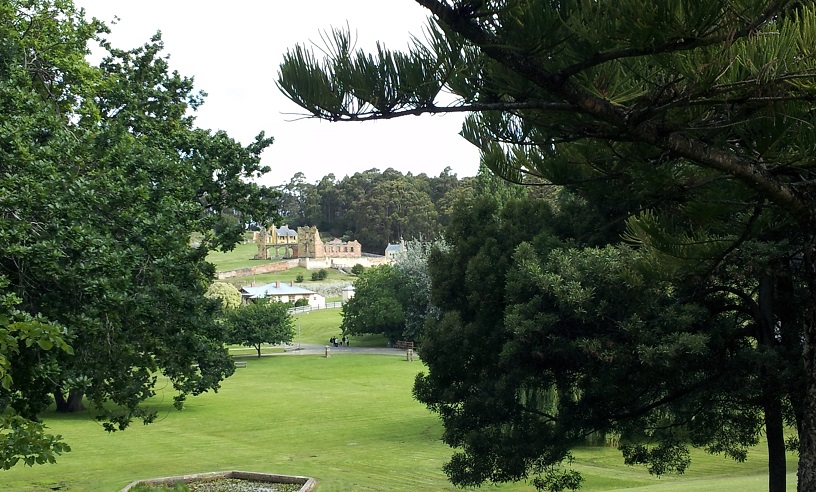
Such a peaceful setting with such a dark history.

I’m writing this post because we are in Australia, and the story of Port Arthur is an essential slice of Australia’s history.
Where Shall We Send Them?

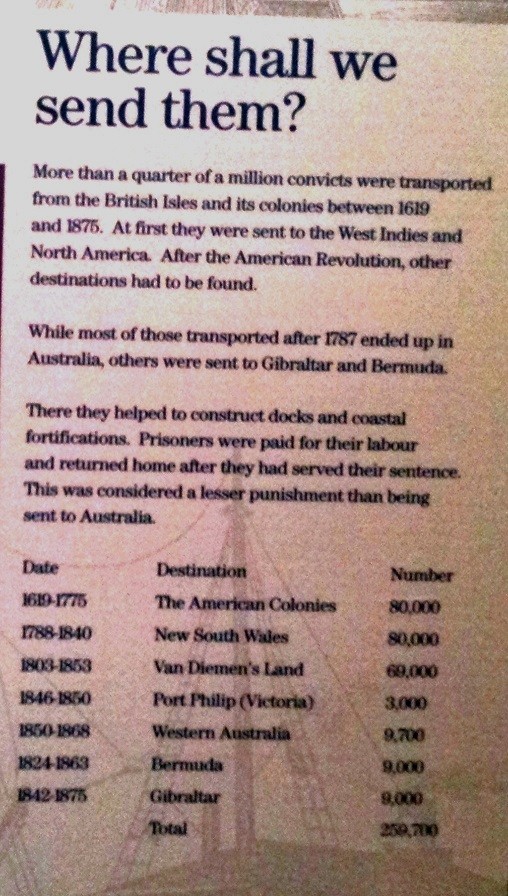
As you may know, Australia was settled by the English in 1830 as a penal colony. London at that time was in an economic depression. War with France had left them with huge debts, unemployment was extremely high, the hungry and homeless crowded the streets and petty crime was out of control. The ever growing prison population was being contained in the hulls of old ships but these too were overcrowded. Transportation – a term used for shipping prisoners off to other places – had been in practice for years.  America and the West Indies were two of the top choices, or had been until the pesky colonists won their independence and shut the prison door to America.

Australia became the next choice and Sydney was the home of the first settlement. Port Arthur, located in the extreme southeastern corner of Tasmania, was established to punish convicts who had committed additional crimes while under sentence in Australia.  It was a massive, 30 acre complex that at its peak housed over 1800 hardened criminals. Penal theory, at that time, was that evil could be ground out of criminals (“grinding rouges into honest men”) by a four pronged approach, education, hard work, religion and harsh discipline.  England wanted the prisons to be self-sufficient so everyone was taught a trade.  Hard work consisted of felling trees, pulling plows, sawing logs, making bricks, building etc.  Religion consisted of being preached a message of fire and brimstone twice every Sunday.  Discipline could consist of chain gangs, double chains for increased punishment, solitary confinement for months at a time but was most often the cat-o-nine tails and was meted out for anything from making eye contact with a gaoler (jailer), to stealing food, to assault.
A Lieutenant Governor's Report
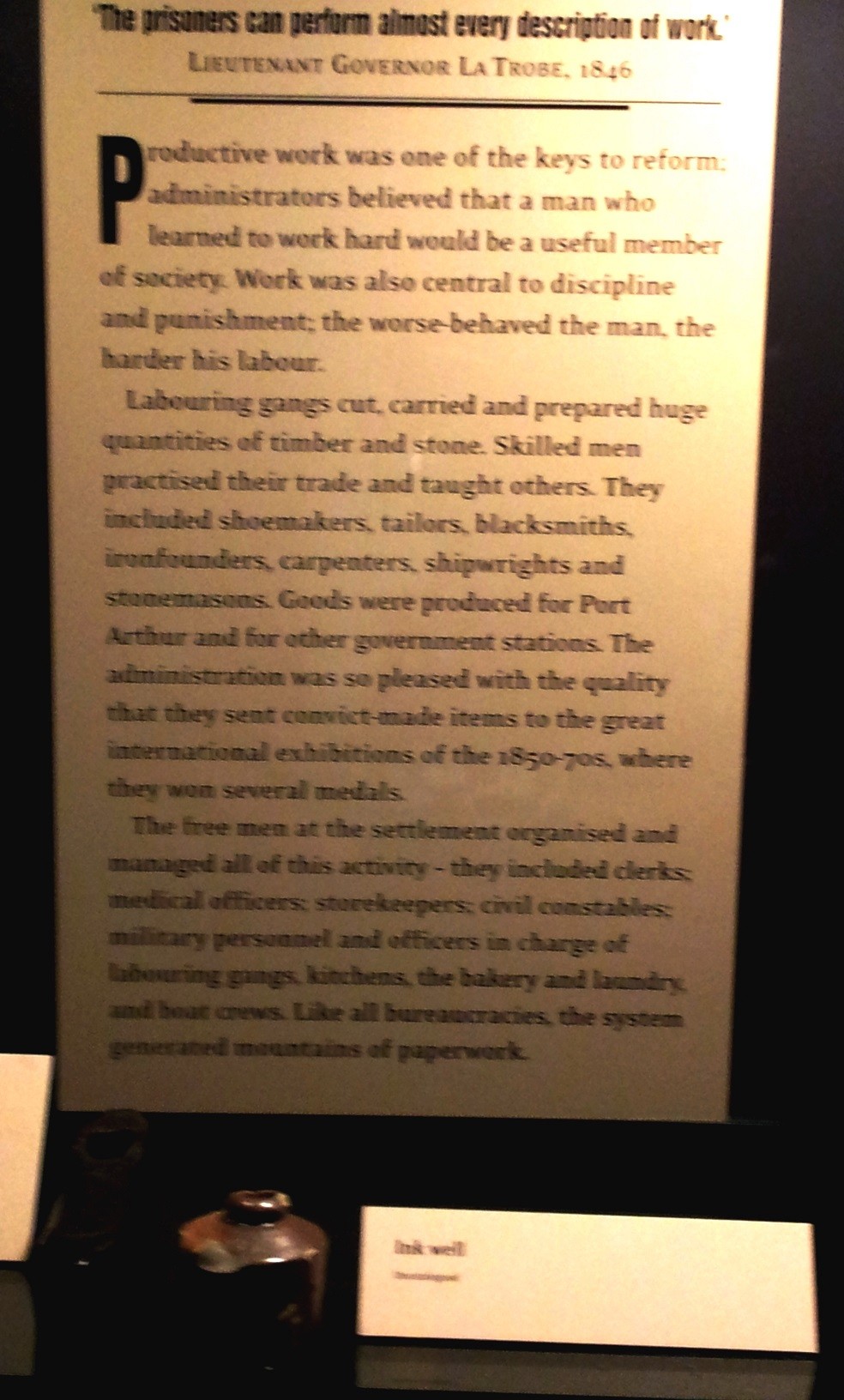
A Lieutenant Governor’s report on the state of the prison.

20070816094746cat-o-nine-tails_psf[1]
Cat-o-nine-tails
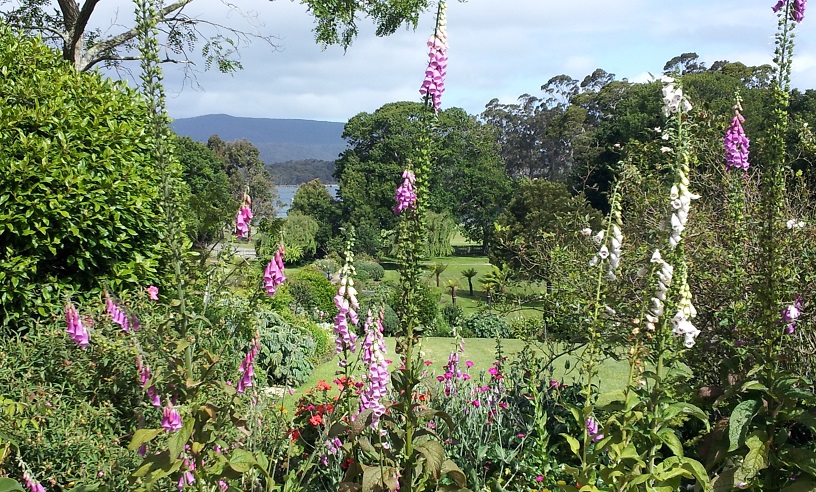
Tom and I found the place fascinating and ended up spending a day and a half taking the tours, reading the plaques and roaming the grounds.  The grounds, as you can see, were beautiful and belie the darkness that was Port Arthur in the 1830s.

The grounds are serene and  beautiful.
The grounds are serene and beautiful.

As we have found in all of Australia’s national parks and museums, Port Arthur is well signed and signs and guides do a wonderful job of setting the stage and telling the story. With our entry tickets, Tom and I each received a playing card (6 of spades & 4 of clubs). In the museum we each matched our cards to a display of plaques and the plaque that matched our card told us who we were – our convict name and what crime we had committed.
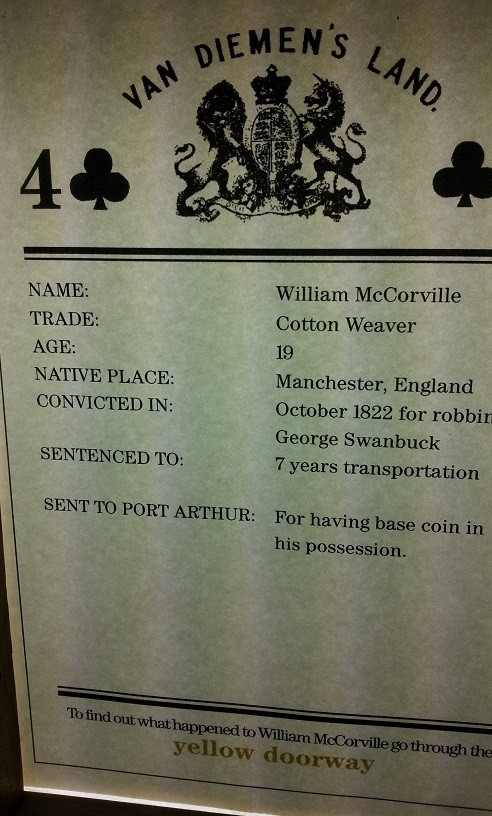
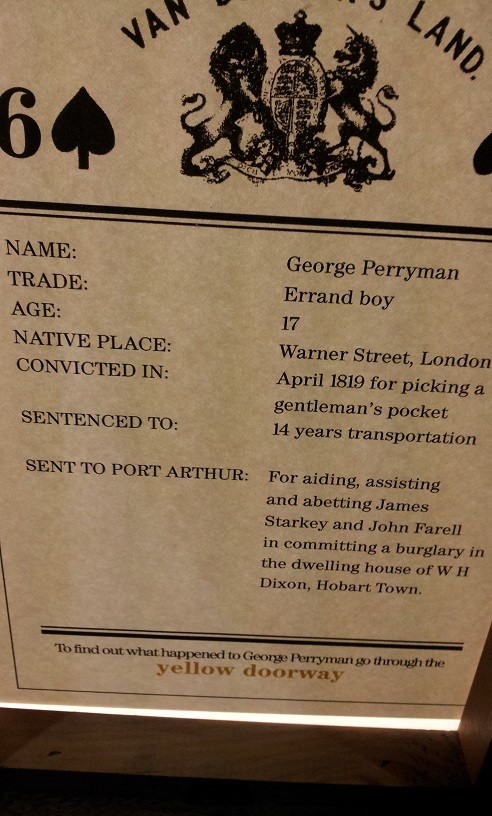
This was Tom
This was Tom.
This was Charli
This was Charli.

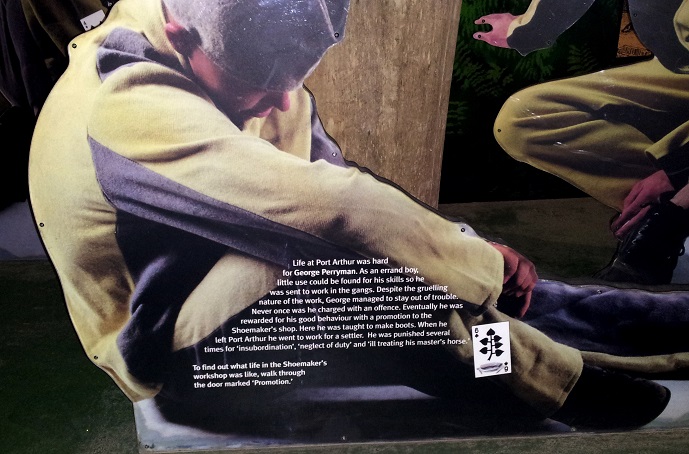
As we wound our way through the museum, we found out more details about our fates as convicts. The records kept at that time were meticulously detailed and our convicts had been actual people. (Click on the pictures to read the story.)
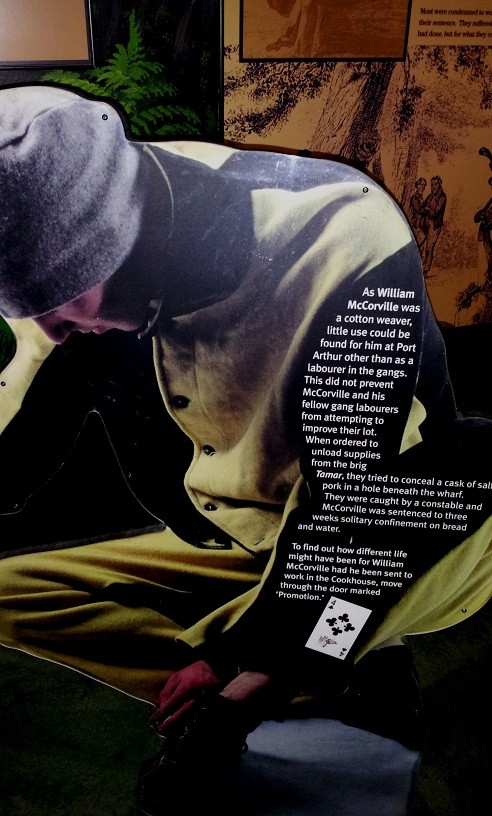
Tom's story continues.
Tom’s story continues.
Convict stories in the museum.
Charli's story continues.
Charli’s story continues.

It was a great, though a bit unsettling, way of immersing ourselves in the wretched atmosphere that was Port Arthur.

After the museum we spent the rest of the afternoon following the map around the beautiful grounds, reading the plaques, listening to the audio story on our headsets, and imagining what it might have been like at the time.

The Guard Towers
The Guard Towers
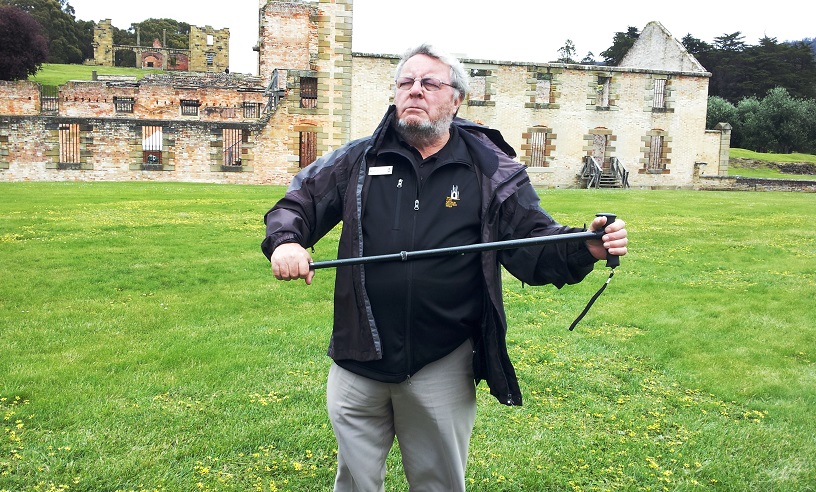
Our gaoler, Lindsay
Linsay, our gaoler (jailer – this is the way it is spelled in Australia). Lindsay gave the introductory tours but did so in the character of a prison guard.

The next day we returned and continued our walking tour,
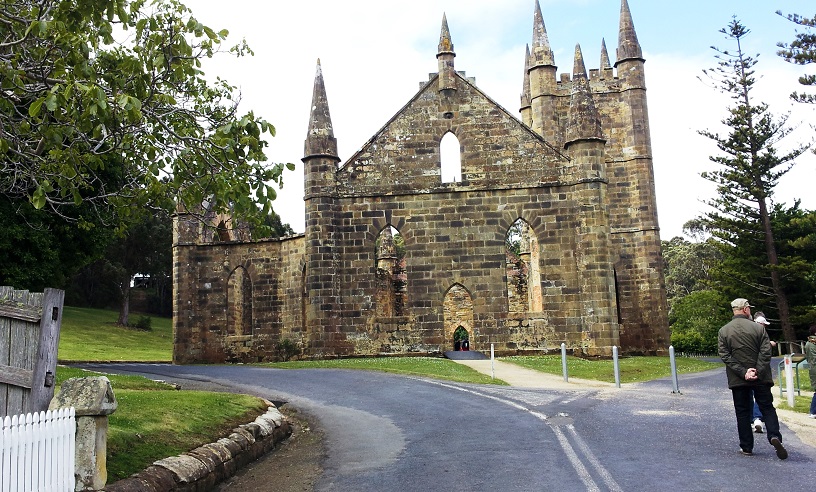
The remains of the church.
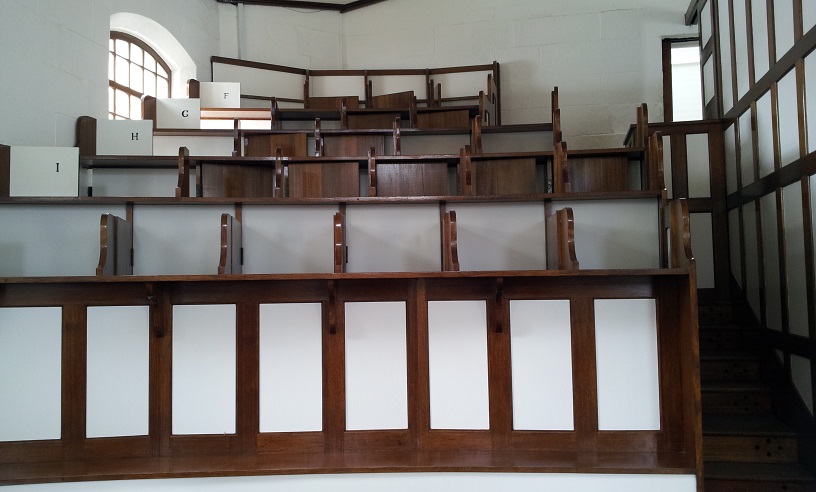
This was a reproduction of the inside of the church. Each convict had a tiny cubical in which to stand. They could only see the preacher who was turned to the side - no eye contact.
This was a reproduction of the inside of the church. Each convict had a tiny cubical in which to stand. They could only see the preacher who was turned to the side – no eye contact.
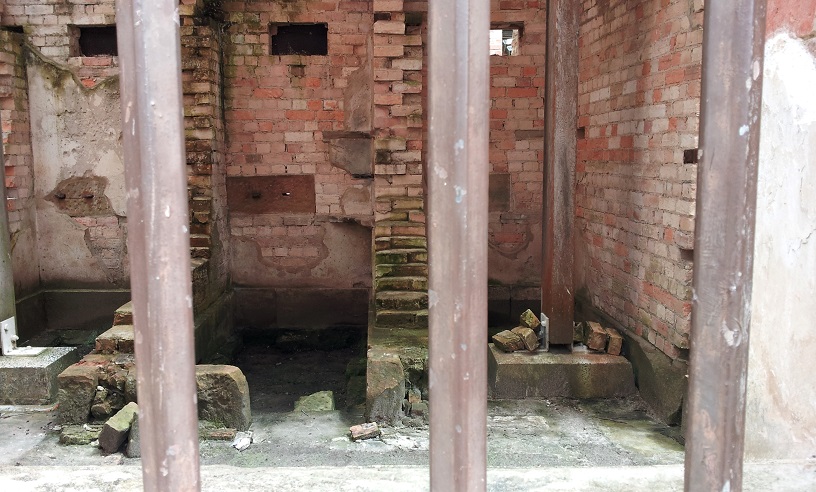
The prison cells were small and cramped.
The prison cells were small, cold and cramped.
The Penitentiary
The Penitentiary
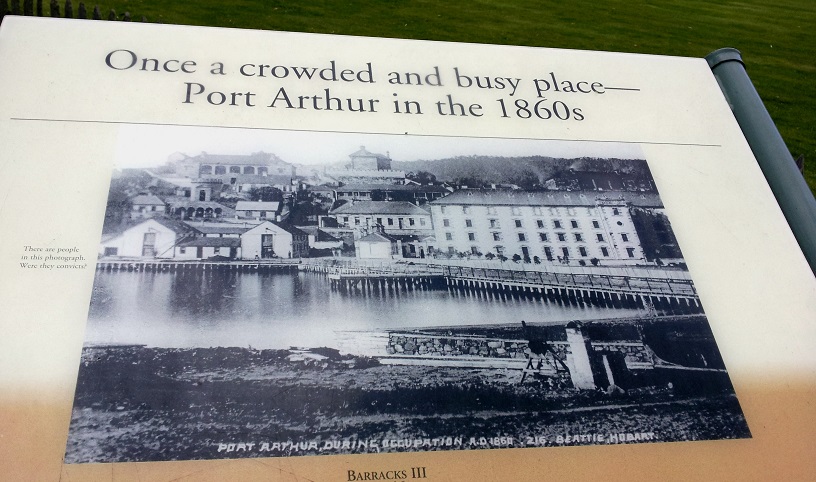
Photograph of Port Arthur in the 1860s.

and after lunch we took the ferry to two small islands in the harbor of Port Arthur.

Point Puer Boys' Prison
Port Arthur Harbor
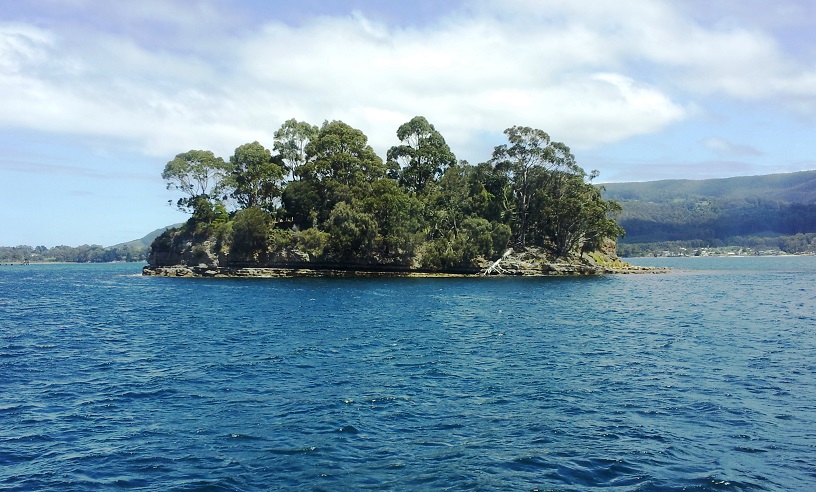
The Isle of the Dead - where those who died during the operation of this penal colony.
The Isle of the Dead – where those who died during the operation of this penal colony.

The first stop was a tour of the Isle of the Dead. As the name suggests, this was the cemetery for those who died at Port Arthur – both convicts and civilians. The surprising thing about this is that, given the times and the nature of the facility, so few people died. The fact is that life expectancy was quite a bit better for those who were transported to Port Arthur than it would have been if they had remained in London. Records show that convicts who completed their sentences and were freed almost never chose to return to England. It is also said that some convicts in London purposely committed crimes in hopes of being to be transported to Australia – pretty interesting.

The boys' prison - such a pretty place with such awful memories.
The boys’ prison – such a pretty place with such grim memories.

The next stop was even more interesting. It was to Point Puer also known as Boys’ Island. It was set up as a boys’ prison in 1834, to separate the boys in order to keep them from being brutalized by the men. Some of the boys incarcerated here were as young as 9 years old – how sad is that?

The theory for reform was the same for the boys as it was for the men – discipline, education, hard work and religion. Work hours were long and hard and discipline severe, but these boys were taught a trade – stone cutting, carpentry, shoe making, ship building… which they were expected to do despite the weather which, in Tasmania, could be harsh. Again, life was hard, but in London, for the poor (75% of the population), the infant mortality rate was 50%. For those babies who survived, another 50% of them died before the age of 12. In short the death rate for children born in poverty in London, at that time, was a staggering 67%. For the boys incarcerated at Point Puer, the mortality rate was 3%, and the 97% who survived were taught a trade so that they could continue to survive. So, dark as Port Arthur’s past might have been, it seems there was a silver lining for some.
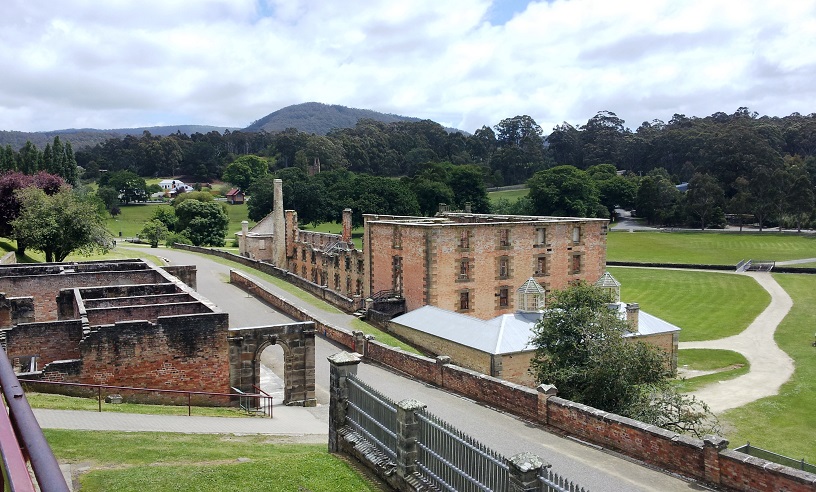
Some years after the close of the prison in 1877, bushfires destroyed many of the remaining buildings.

Transportation ended in 1853 and the prison at Port Arthur closed in 1877.  A brush fire destroyed many of the buildings and a reporter, at the time, wrote “What was Port Arthur is doomed to rot and decay…”. Instead, curiosity seekers began coming to have a look and enterprising entrepreneurs saw the potential and turned it into a very successful tourist attraction – very smart.

So this is the story of Port Arthur – a part of the inauspicious beginnings of a new and, what is now, a thriving nation – Australia.
Real Live Tansmanian Devils

Lots of Roo
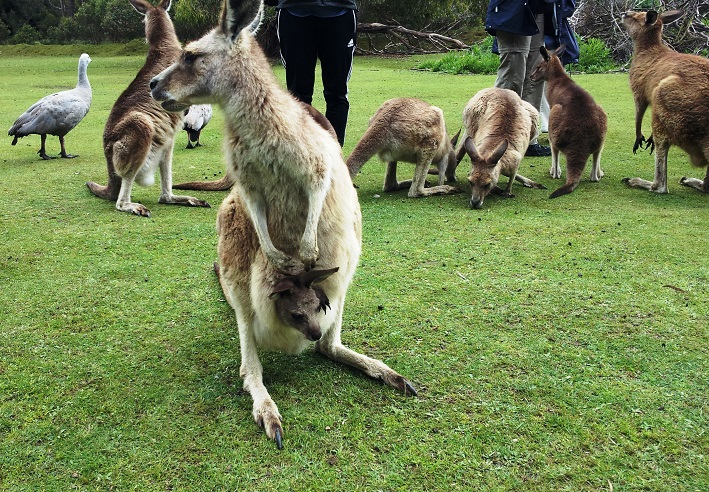
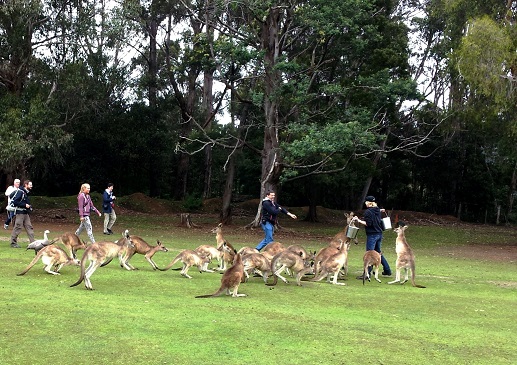
Lots of Roos – mostly Australian Grey Kangaroos.

Today it was off to the Tasmanian Devil Preserve where we got to see wallabies in the bush, watch the feeding of real live Tasmanian devils and quolls, and to actually feed kangaroos and pademelons – very touristy but lots of fun.

If you are like Tom and me you might be thinking, “I’ve heard of kangaroos, wallabies, and even Tasmanian devils but what the heck are quolls and pademelons?” Well, let me tell you. Both are marsupials (the group of mammals commonly thought of as pouched mammals). Like kangaroos and wallabies, they give birth to their young and then the tiny newborn makes its way to the mother’s pouch where it lives snuggly and warm until it is big enough to be on its own. Possums are an example of marsupials in the US.

We also learned that a joey (baby kangaroo) stays in the pouch for anywhere from 7 to 9 months. While that little one is in the pouch, she can give birth to a second who also crawls into the pouch. Luckily the mother has two nipples so both can nurse. Okay, this is the amazing part, while she has two in the pouch, mama kangaroo can become impregnated again but she can hold off giving birth to #3 for two or more months until the oldest joey leaves the pouch. The mama kangaroo is like a baby making machine. It’s no wonder the kangaroo populations are growing so large.

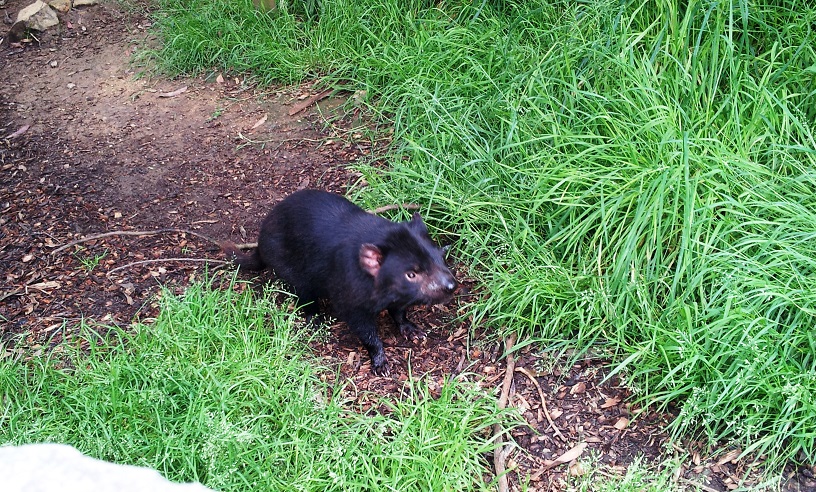
A real live Tasmanian devil. They look like tiny little black bears.
A real live Tasmanian devil. They look like tiny, fat little black bears.

We arrived just in time to catch the end of one of the Tasmanian devil feedings – pretty interesting. There are 2 stories about why they call them devils. One is that when settlers first landed, they would here the loud Tasmanian devils calls in the night and thought that they must be devils. The other is due to their feeding habits. Tasmanian devils (also marsupials by the way) are voracious, carnivorous animals and they eat every part of their prey, and I mean every last bit – bones, fur, nails, innards… you got the picture. Well, you probably don’t want the picture but you get the idea.

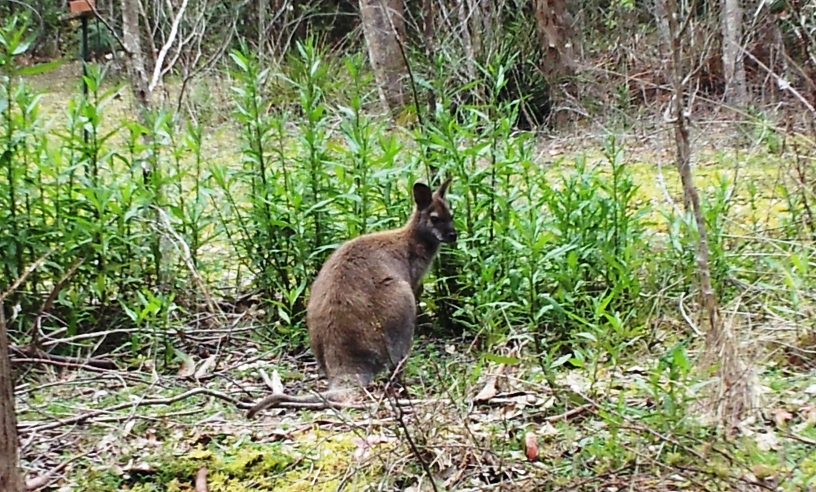
A wallaby in the brush. They are too cute.
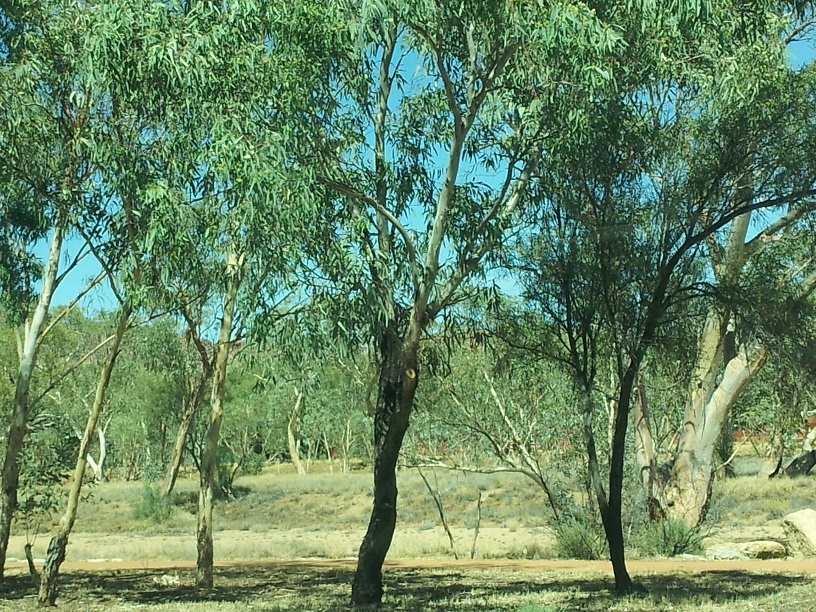
This was part of the kangaroo compound which was huge. There were eucalyptus trees everywhere and they smelled wonderful.
This was part of the kangaroo compound which was huge. There were eucalyptus trees everywhere and they smelled fresh and wonderful.

Then it was off to hike to the stream where along the way we got to see a red-necked wallaby in the woods, very cute. They are smaller and have pointier faces than the kangaroos.

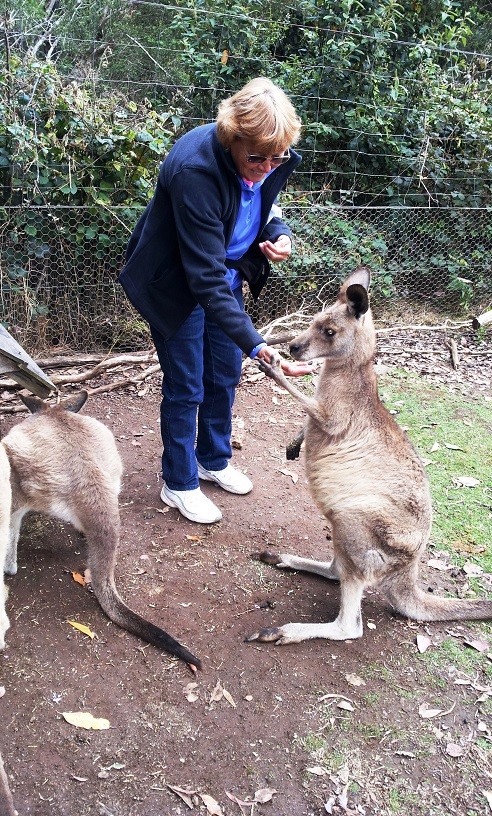
From there we headed back to the kangaroo compound for the morning feeding of the roos. This was very fun and we participated energetically as you can see from the pictures.

Tom feeding the Kangaroos
Charli feeding a Kangroo. He was holding my hand with both of his while he ate.
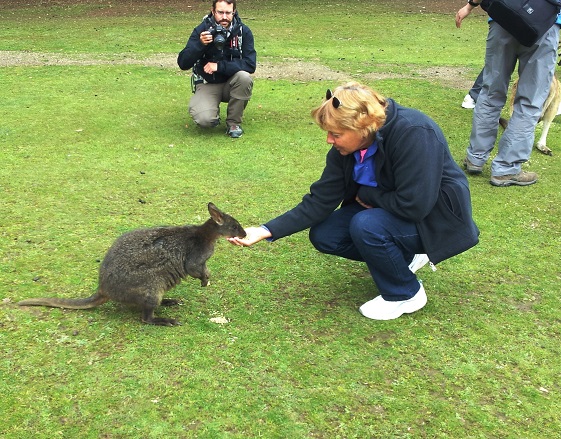
Charli feeding the pademelon.
Charli feeding the pademelon..
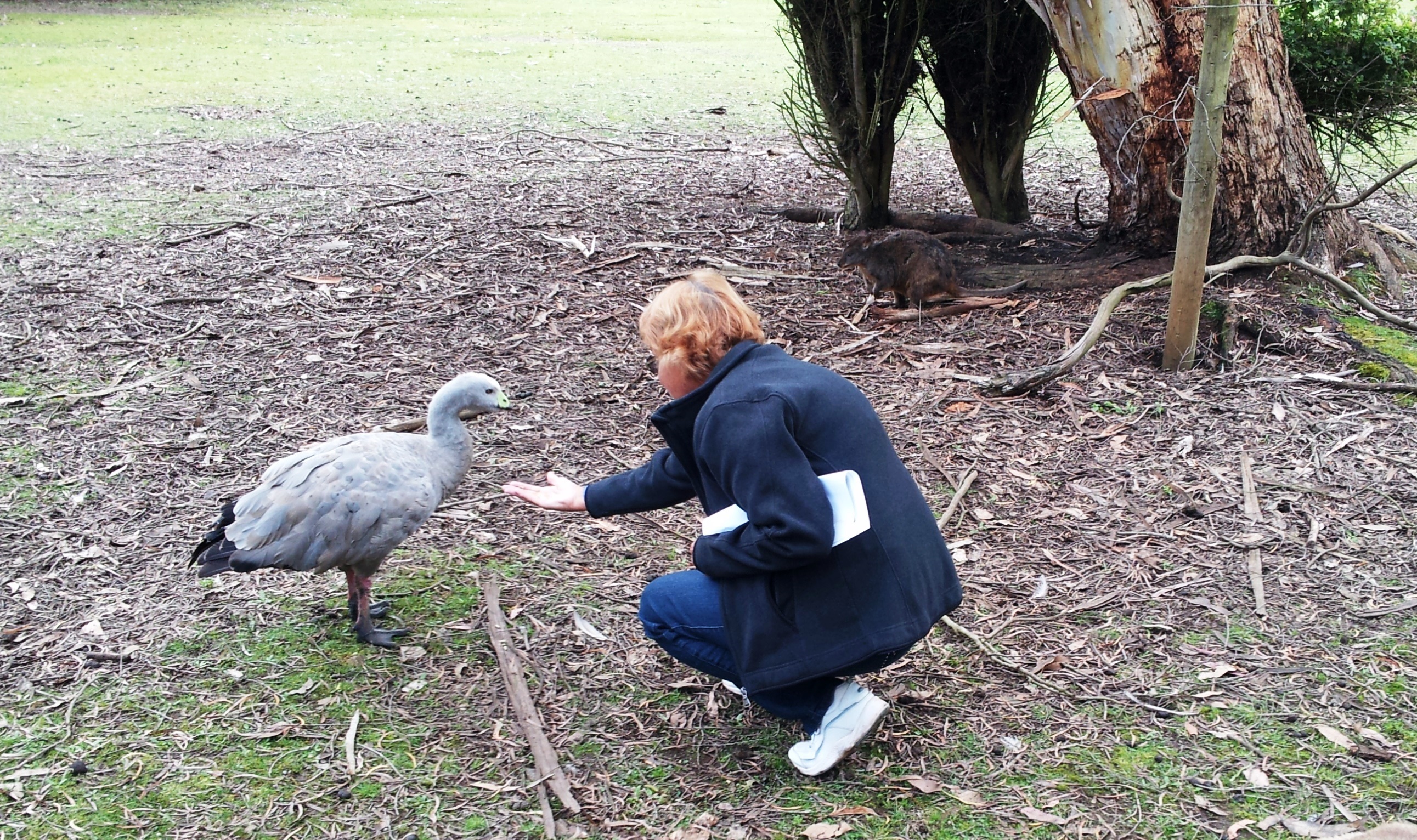
Charli with an Australian grey goose. Look closely, his bill is green.
Mamma and her joey. The joeys can stay for up to 9 months in the pouch. They come out to get a snack and play then crawl back in - Kind of like a Hop-on-hop- off bus.
Mamma and her joey. The joeys can stay for up to 9 months in the pouch. They come out to get a snack and play then crawl back in – Kind of like a Hop-on-hop- off bus.

The pademelon is a smaller cousin of the kangaroo. Their fur is dark, thick and soft and they are very shy. I was lucky that the one let me feed him.

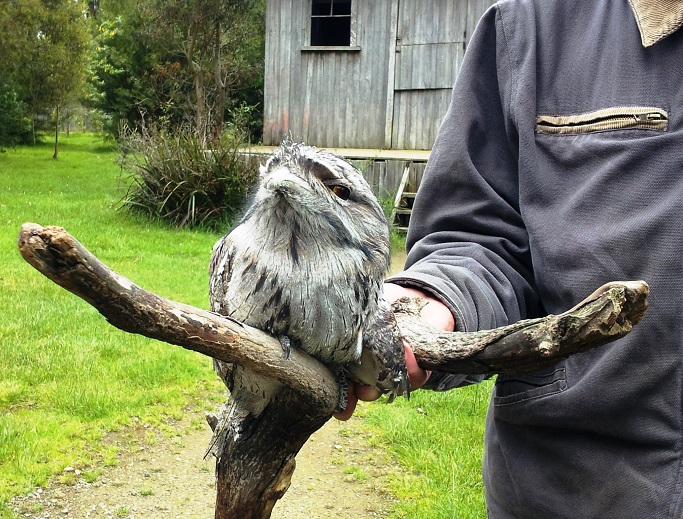
A bird show was next and we got to see cockatoos and best of all a tawny frogmouth. The show was amusing and entertaining and I got to learn about the tawny frogmouth. They are a distant relative of the owl and as you can see they have great camouflage for hiding in trees. They call them frogmouths because they have huge mouths for swallowing their prey.

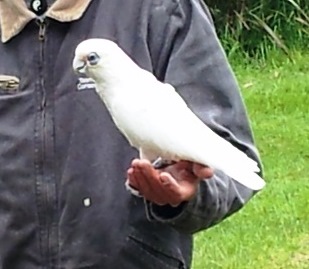
Little Corel cockatoo - Talky
Little Corel cockatoo – Talky
A Major Mitchell Cockatoo named Naughty. They said when he was given to the preserve, his language was not the best - funny.
A Major Mitchell Cockatoo named Naughty. They said when he was given to the preserve, his language was not the best – funny.
Tawny Frogmouth named Sam.

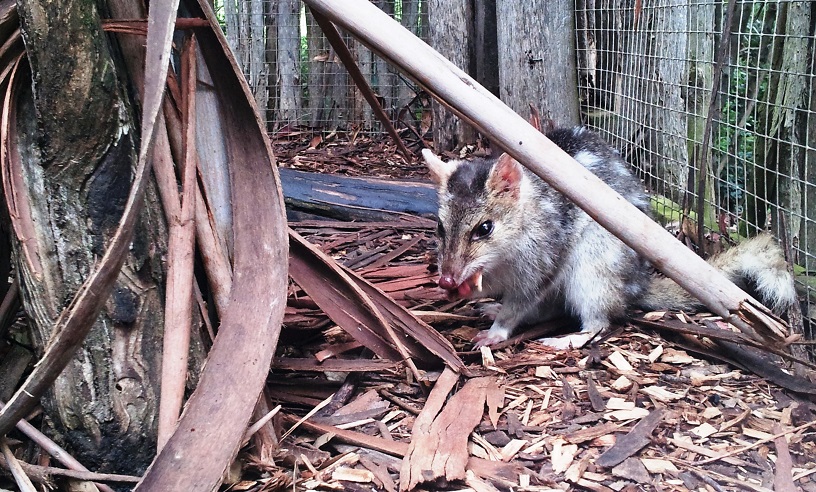
Next was the quoll feeding. They are so cute and so fast. For this feeding, the keeper played a game of hide-and- seek. He hid chunks of meat (quolls are also carnivorous marsupials) around the pen and the two little guys had a great time racing around to find their dinner – very fun to watch.

And here is the real thing, an Eastern Quoll. They're about the size of a rabbit and even faster.
And here is the real thing, an Eastern Quoll. They’re about the size of a rabbit and even faster.

The last stop, another Tasmanian devil feeding – this was a different pair (brothers). Tom and I got there about 15 minutes early and had them all to ourselves. They were so funny and fascinating to watch. Along with being ravenous eaters, they are extremely competitive. They fight over everything – food, partners, territory, you name it and they squabble over it. In the video they look like they’re yawning, but actually it’s a kind of posturing – baring their teeth to show how tough they are – so male but in honesty the females do it too.

When the keeper came, he brought a chunk of raw meat and tossed it in. As per their normal routine, one grabbed it and took off with the other in hot pursuit. They chased around like this growling and snarling for about 10 minutes then the possessor of the feast went into their hut. His brother joined him and took hold of the other side of the meat and they played tug-o-war until the chunk split in half and both ate and grumbled happily. What a production!

All of the animals were interesting and entertaining, but the devils were the best.


But wait, there’s more! It was a long drive to the Tasmanian Devil Preserve and Port Arthur, and I got bored, so I took some pictures of some of the entertaining road signs along the way. I thought I’d share.

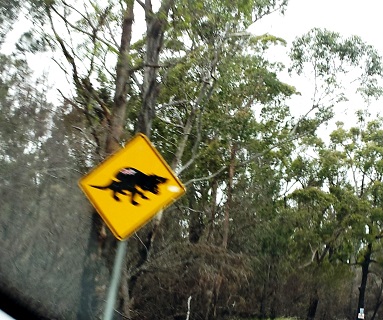
Tasmanian Devil Crossing - Yep, you read it right.
Tasmanian Devil Crossing – Yep, you read it right.
Wombat Crossing - seriously.
Wombat Crossing – seriously?
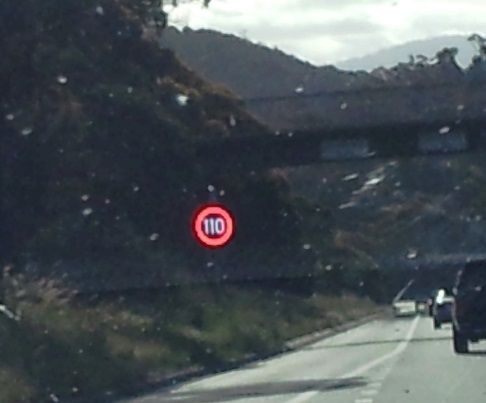
This is a speed limit sign. Wait, wait, don't get your knickers in a twist, it's in kilometers, so only about 66 MPH. (2)
This is a speed limit sign. Wait, wait, don’t get your knickers in a twist, it’s in kilometers, so only about 66 MPH.


Slippery when Frosty
Endangered Bandicoots
Endangered Bandicoots – What the heck is a bandicoot?
Kangaroo Crossing of course
Kangaroo Crossing of course.
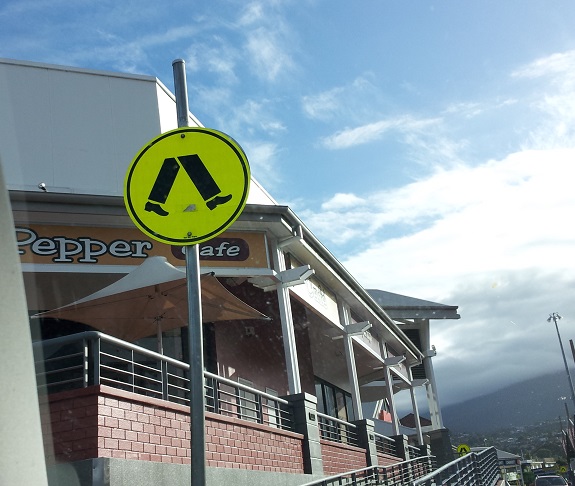
Crosswalk
And this is a people crossing.

Mona

The next day was cold and rainy so we chose an indoor activity – Mona. Other than saying that it is an art gallery, I’m not sure how to describe this place. The terms avant-garde, unconventional, eccentric, edgy are pretty tame. Maybe over-the-edge is closer.

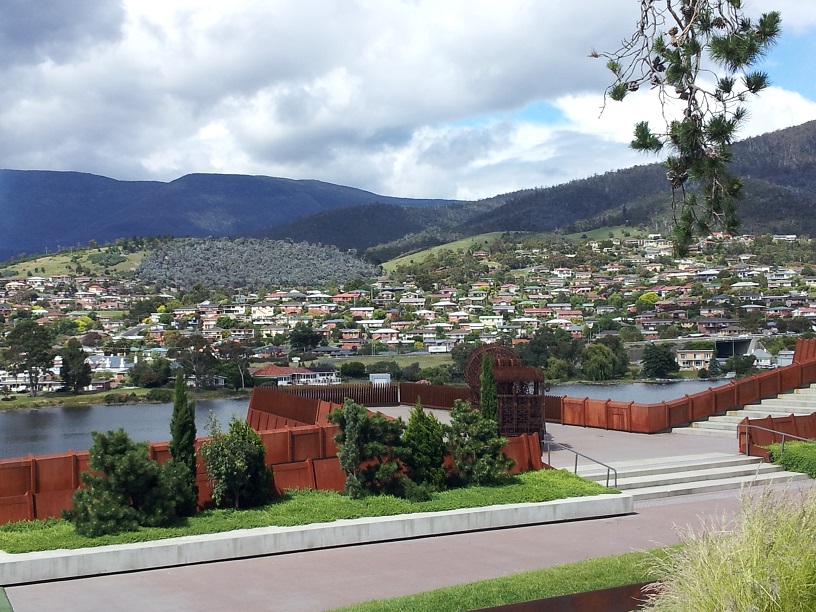
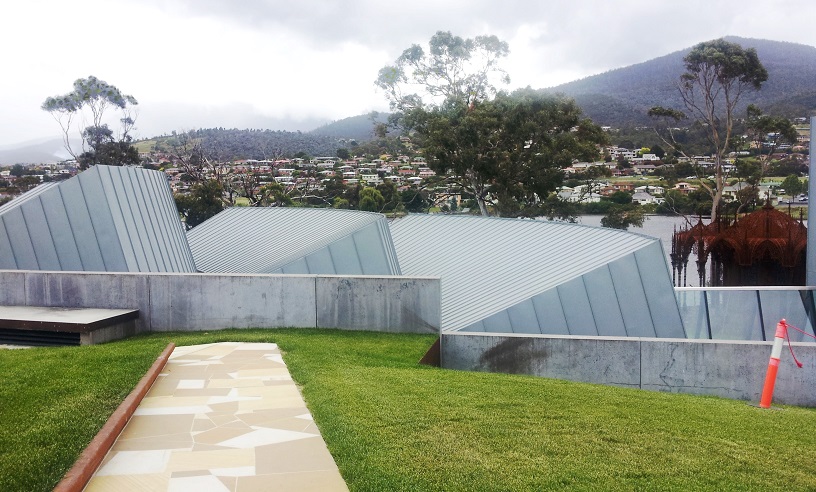
The grounds of Mona with Hobart  across the river.
The grounds of Mona with Hobart across the river.

Anyway, Mona is privately funded directed/controlled by a man named David Walsh. His words probably provide the best insight to his world and Mona.


How does art fit into life? It is a behaviour, a practice, that congeals humanity like the fat in a fry-pan; it clarifies and distills, evaporates the excess, until we can see (just for a moment) into the base of ourselves. And perhaps — let us phrase it as a question. Is human-ness nothing but a set of such behaviours?

The answer, we hope and aim, will remain elusive; there will be no lessons learnt or taught, only contagious inquiry into the messy machinery of human nature.

Parking spaces for David Walsh + 1

Okay, moving right along, we arrived at Mona and as we pulled into the parking lot Tom pointed out the designated parking spaces in the picture and said, “That says it all.” Pretty funny, but I think Tom is correct in assuming that David Walsh has a major and strange ego.

We were directed to the entrance where we paid the entrance fee and received headsets and mp3 players that allowed us to read artists names and captions about each exhibit and to register (love it/hate it) our response to each display. These devices also allowed you to program in your email address to get an electronic copy of your individual tour and your responses – very modern and high tech.

The gallery is built into the side of a hill so for the most part is underground.  The carved sandstone provides much of the wall and some of the ceiling throughout the building and it was beautiful – form and function.

This is the roofline of the gallery.
The dimly lit gallery wandered in and out, up and down. This was taken from the top balcony.
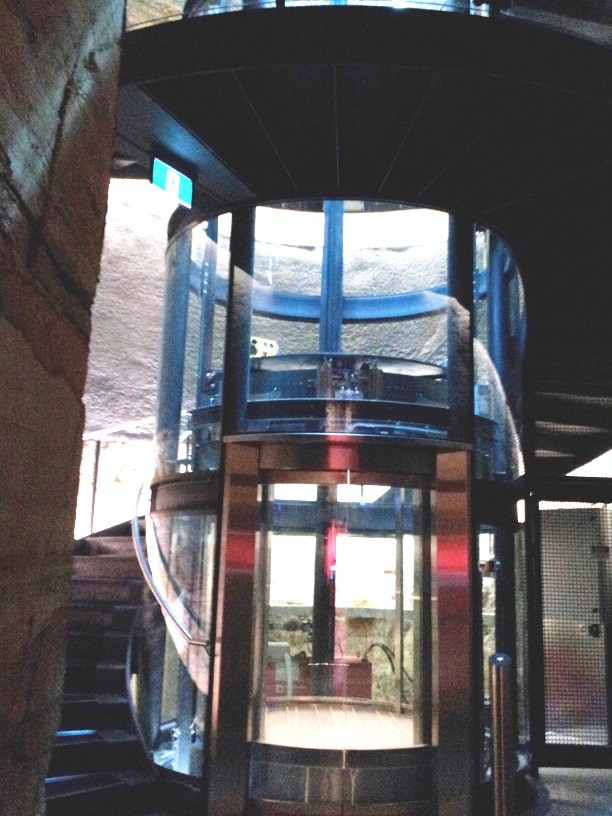
This is the cylindrical elevator with the staircase wrapped around.

 We took the stairs (a circular staircase that wound around a cylindrical elevator (again, beautiful form and function) down four stories to the recommended beginning of the exhibit.

We spent the next four hours wandering through a dimly lit, very Alice in Wonderlandesque world of “art”. Some of it was beautiful, much of it very disturbing (I chose not to add those to my photo gallery), a fair share intriguing, a great deal of it was just plain bazar. That’s my summation and I’m sticking to it.

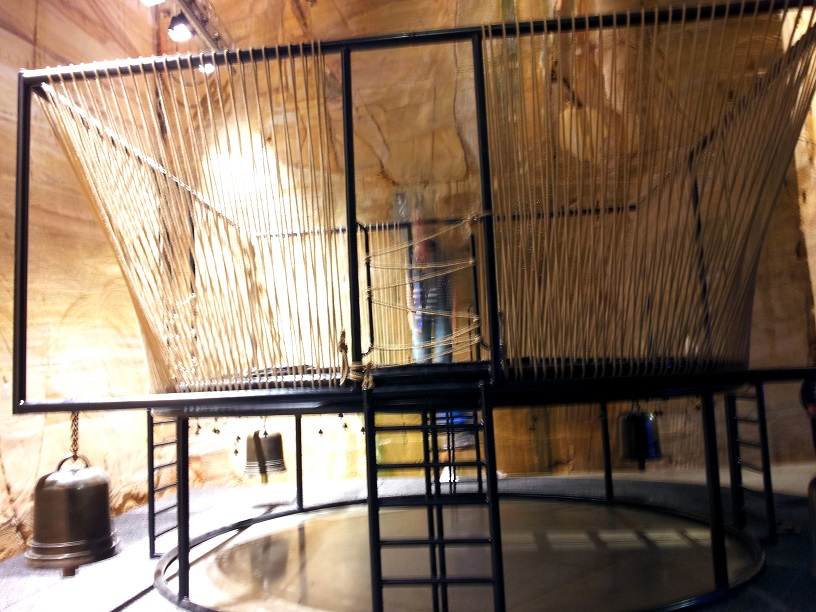
This is a large trampoline with the objective of jumping hard enough to ring the bells-fun.
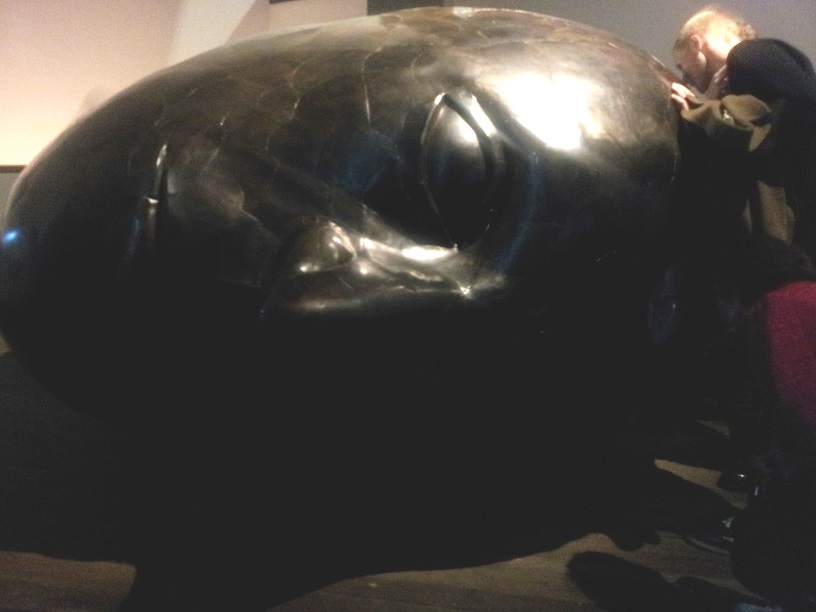
This display was pretty cool. It's a huge head lying on its side with windows to the inside.  The next video is taken of the inside. It's pretty dark but the display was very intriguing.
Dreaming – This display was pretty cool. It’s a huge head lying on its side with windows to the inside. The next video is taken of the inside. It’s pretty dark but the display was very intriguing.

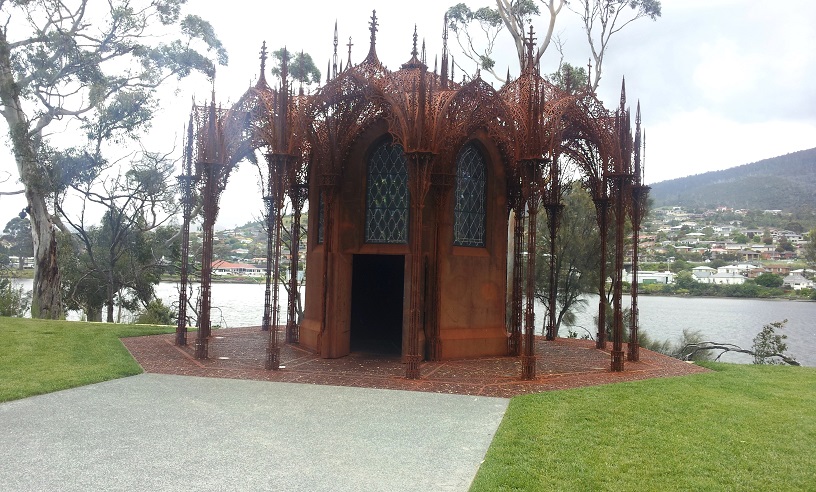
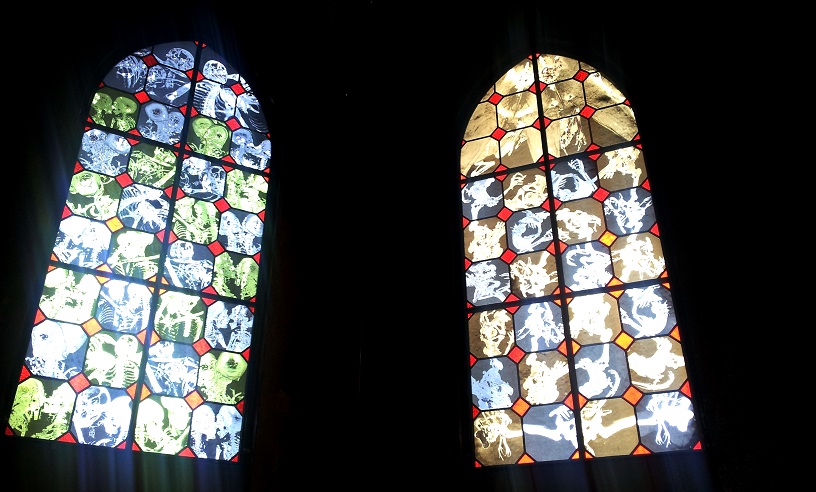
The title ot this structure is The Wedding Chapel - intricate and ornate. Wait until you see the stained glass windows.
The title of this structure is The Wedding Chapel – intricate and ornate. Wait until you see the stained glass windows.
The windows in the Wedding Chapel. (Click on the picture to see full screen). See what I mean about disturbing.
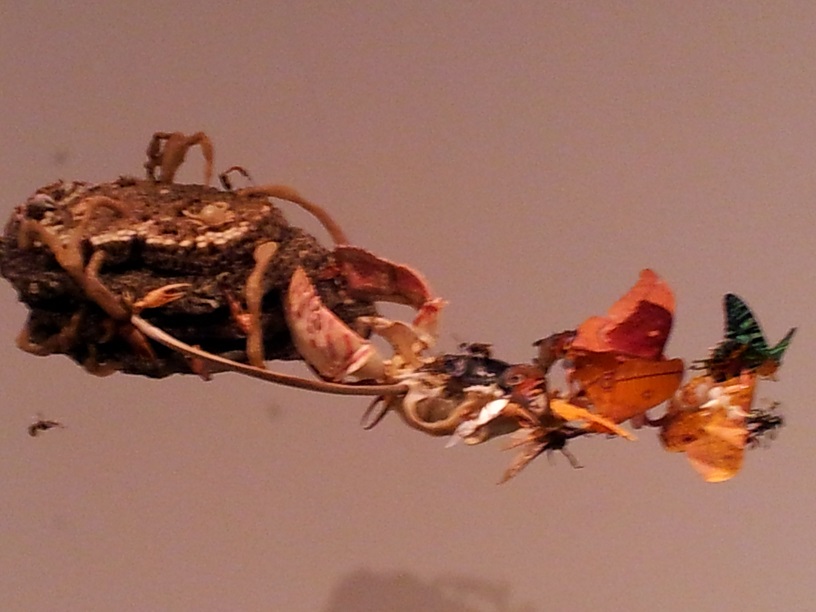
2 This objet-de-art was made of real (dead) insects, leaves, nest, etc.
This objet-de-art was made of real (dead) insects, leaves, nest, etc.
Art mimicking nature.
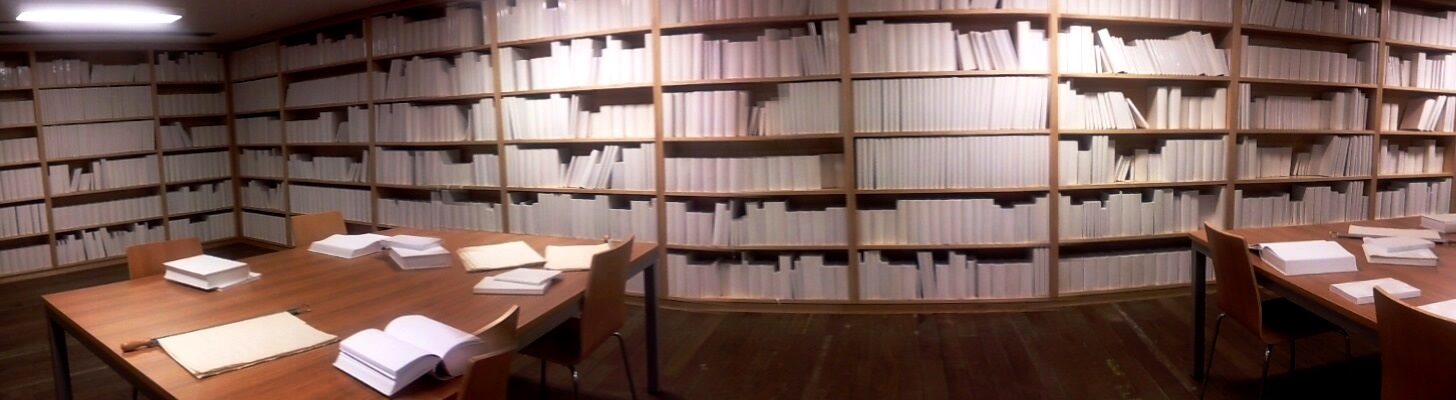
This was a whole full-sized room filled with blank books and empty writing paper. Maybe the artist felt that noone had anything worth saying.
This was a whole full-sized room filled with blank books and empty writing paper. Maybe the artist felt that no one had anything worth saying.
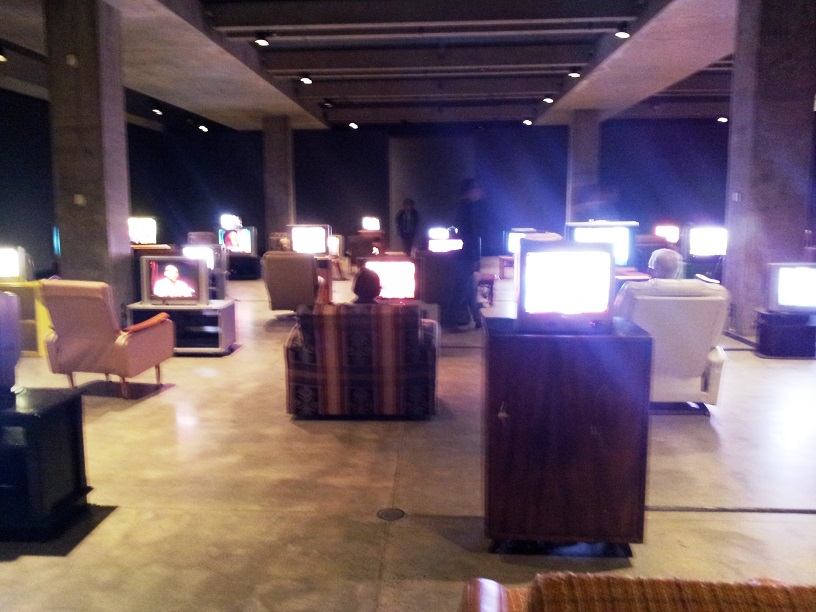
This display was a  very large room full of TVs each playing an interview  with a different person. I have no idea what  it meant.
This display was a very large room full of TVs each playing an interview with a different person. I have no idea what it meant.
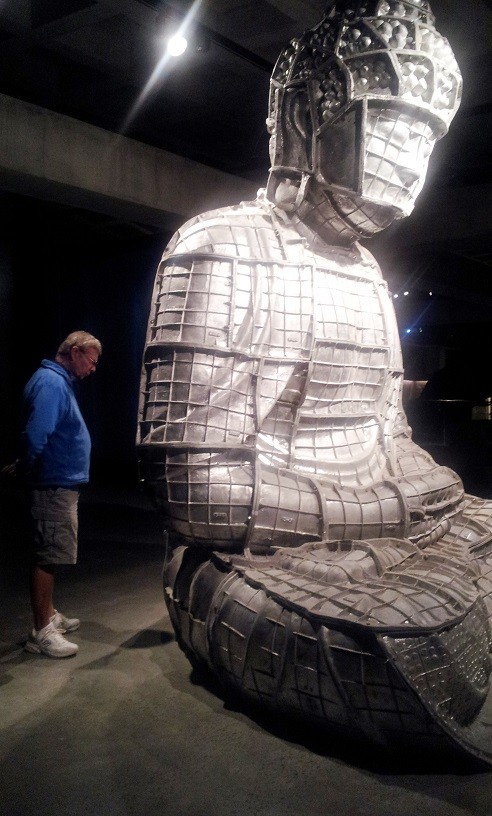
Some of the statues were quite large. Tom and I both liked this one.
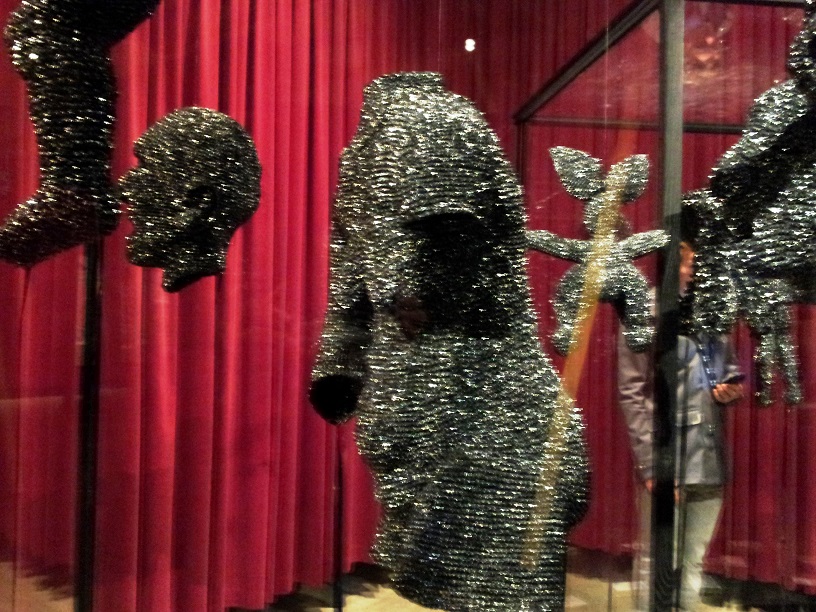
The pieces in this display were all knitted. Traci, I took this one just for you.

The Crossing Guard was my favorite display.

I will, however, say that my favorite part of Mona is the architecture both building and the grounds. Where much of the art was frenetic and disturbing, there is a quiet grace in the building itself and in its surroundings.

Fun sculptures - pretty ornate for a cement  truck.
Fun sculptures – pretty ornate for a cement truck.
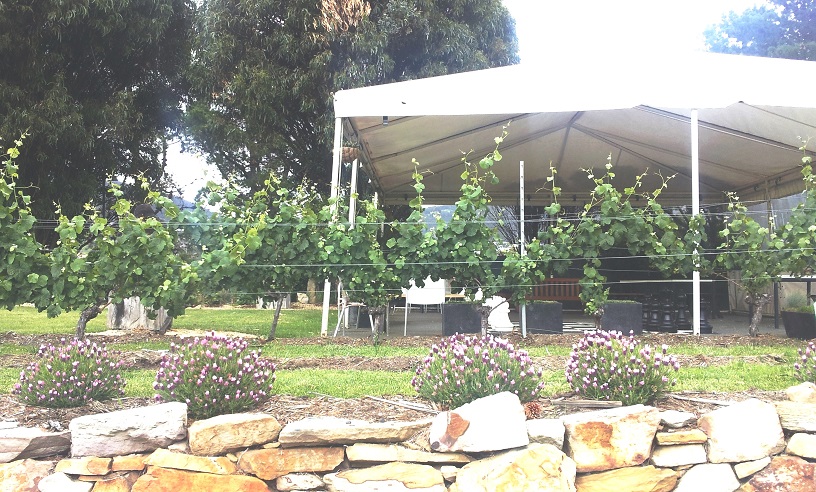
Gazebo and vineyrds
Gazebo and Vineyards
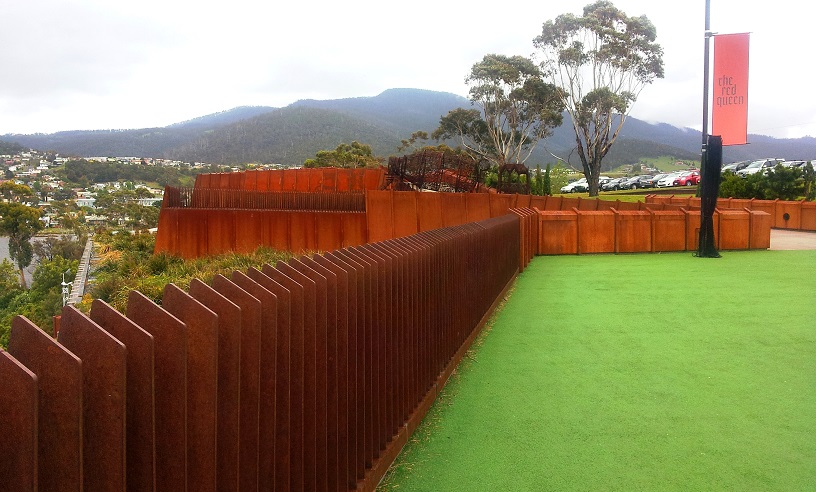
This is the courtyard just outside the entrance. The wind was blowing  which caused the  flat metal fence posts to hum a harmonica-like tune.
This is the courtyard just outside the entrance. The wind was blowing which caused the flat metal fence posts to hum a harmonica-like tune.

The sidewalks, palisades, sculptures, sloping lawns, vineyards, and gazebos as well as the panoramic views of Hobart across the river all combined to create a tranquil counterpoint to the gallery’s displays.

All-in-all, it was an interesting way to spend a cold, rainy Tasmanian day.

Where the Devil is Tasmania?

Tasmania
Tasmania

Where the Devil is Tasmania?

Tasmania is a state in Australia – yep, they have states. Tasmania is an island at the southern tip of Australia which puts it at the farthest point in Australia from the equator. It still seems weird to me that in this part of the world, the farther south you go the colder it gets, , does that make any sense to you? In fact Tasmania is just shy of being closer to Antarctica than it is to the equator.

Anyway, having had your geography lesson for the day, let’s leave it at that we went from lows in the 80°s – highs of 104° in  the Outback to lows in the 30°s – highs in the 60°s in Tasmania. On top of that, we changed time zones again – no wonder I’m confused…
To add to the confusion, we rented a car here and THEY DRIVE ON THE WRONG SIDE!!!! Plus the roads are very narrow. Tom did all the driving, and I did most of the white-knuckle gripping of the armrest and gritting of the teeth. I’m proud of Tom – not one scratch or dent (on the car).

But on with the trip, we stayed in Hobart, the capital of Tasmania, at a great little place called Graham Court where we had a small apartment and cooking facilities – back to home cooked meals, yea!!! Hobart is what I would call a large sprawling town. It is hilly, green and lovely with pretty little houses and flowers in the yards, along the roads, in the meadows… serene tranquility (except for when we were driving).

Driving into Hobart
Driving into Hobart
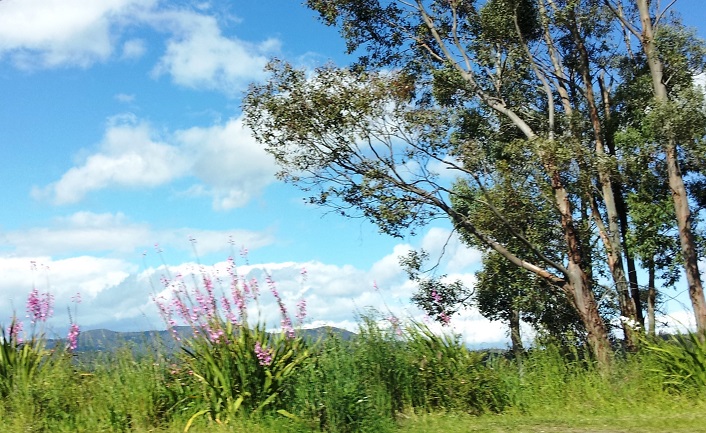
A very pretty type of geranium. It grew everywhere.
Charming houses
Charming houses
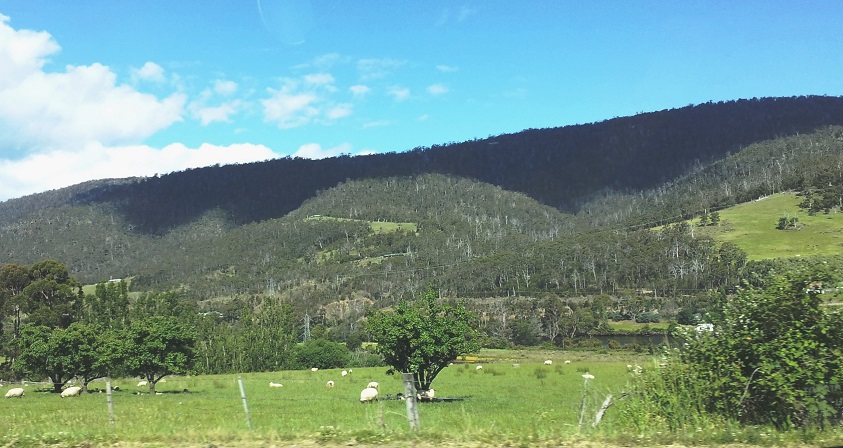
Grazing sheep
Grazing sheep
Quiet lush vineyards
Quiet verdant vineyards
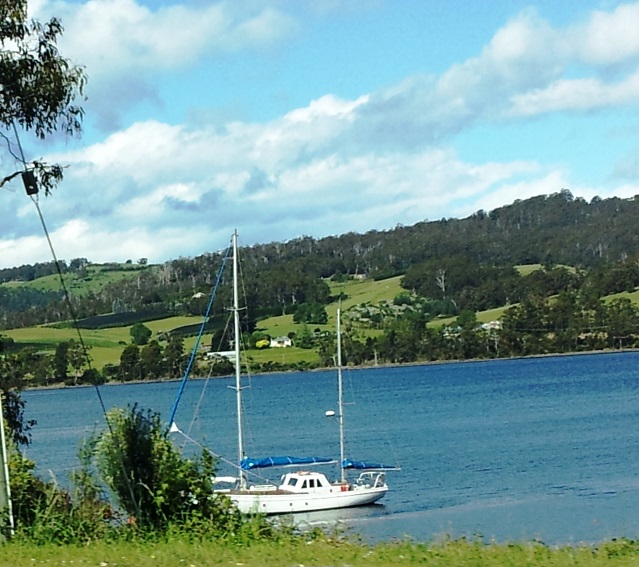
The countryside was beautiful everywhere we went.
Pretty, peaceful, pastoral settings.
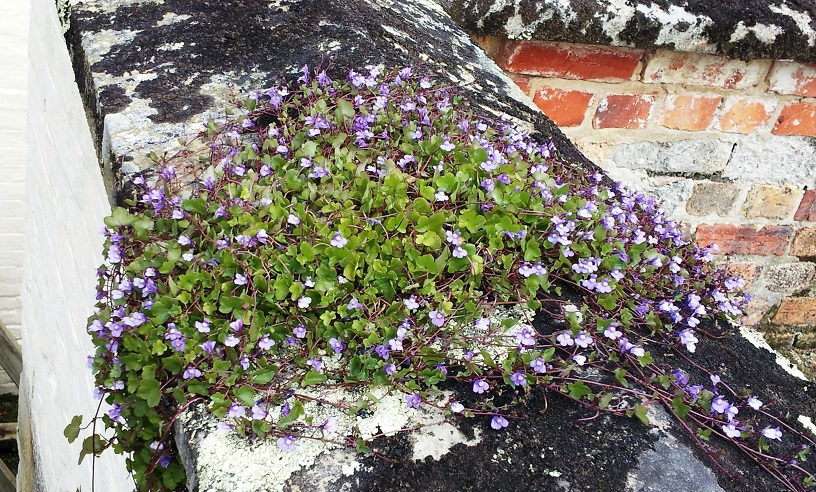
This pretty little ground cover grew right on the rock - no soil.
This pretty little ground cover grew right on the rock – no soil.
Tranquility
Tranquility

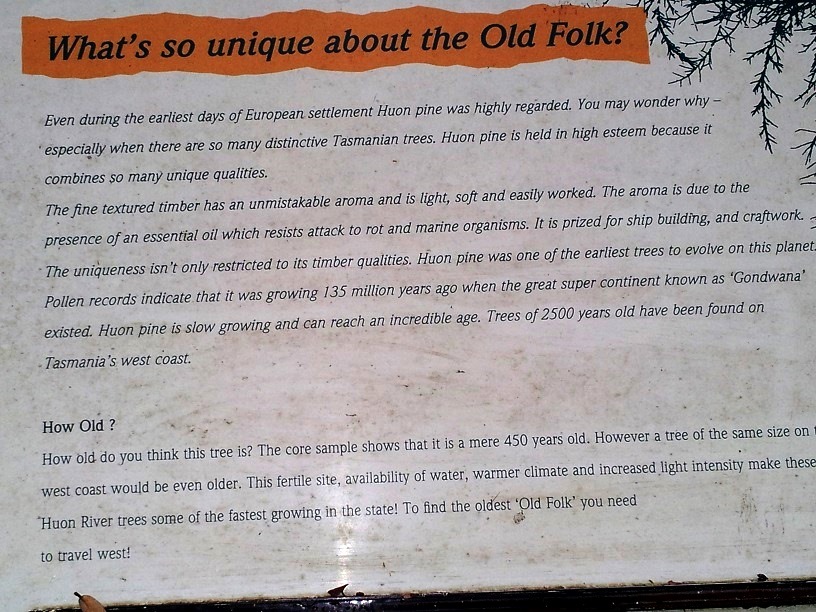
We spent our first full day at a place called Huon National Park. Huon is a type of pine tree that grows in this area and has beautifully grained wood that they use for building everything from ships to salt and pepper shakers. Huon National Park is a mixed forest – evergreens, deciduous trees (including gigantic eucalyptus trees), ferns, mosses, etc. – lush and fragrant.

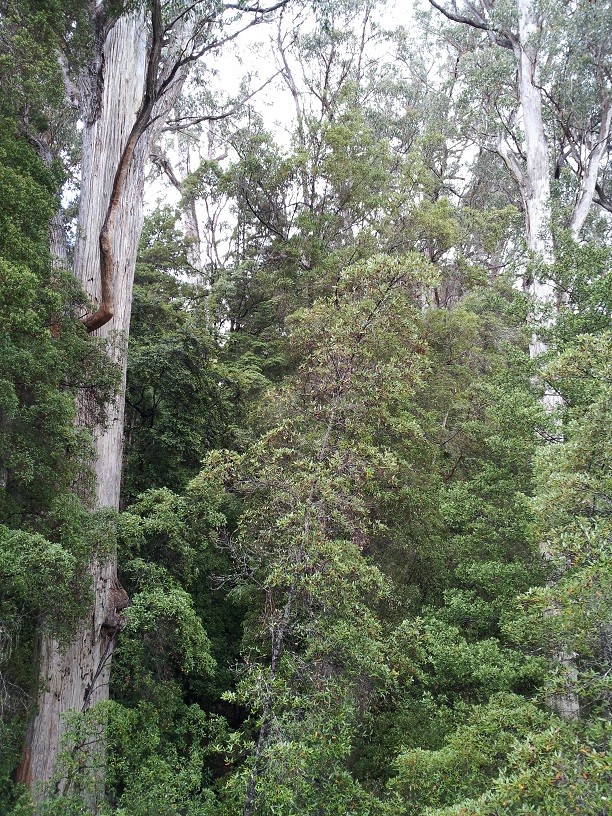
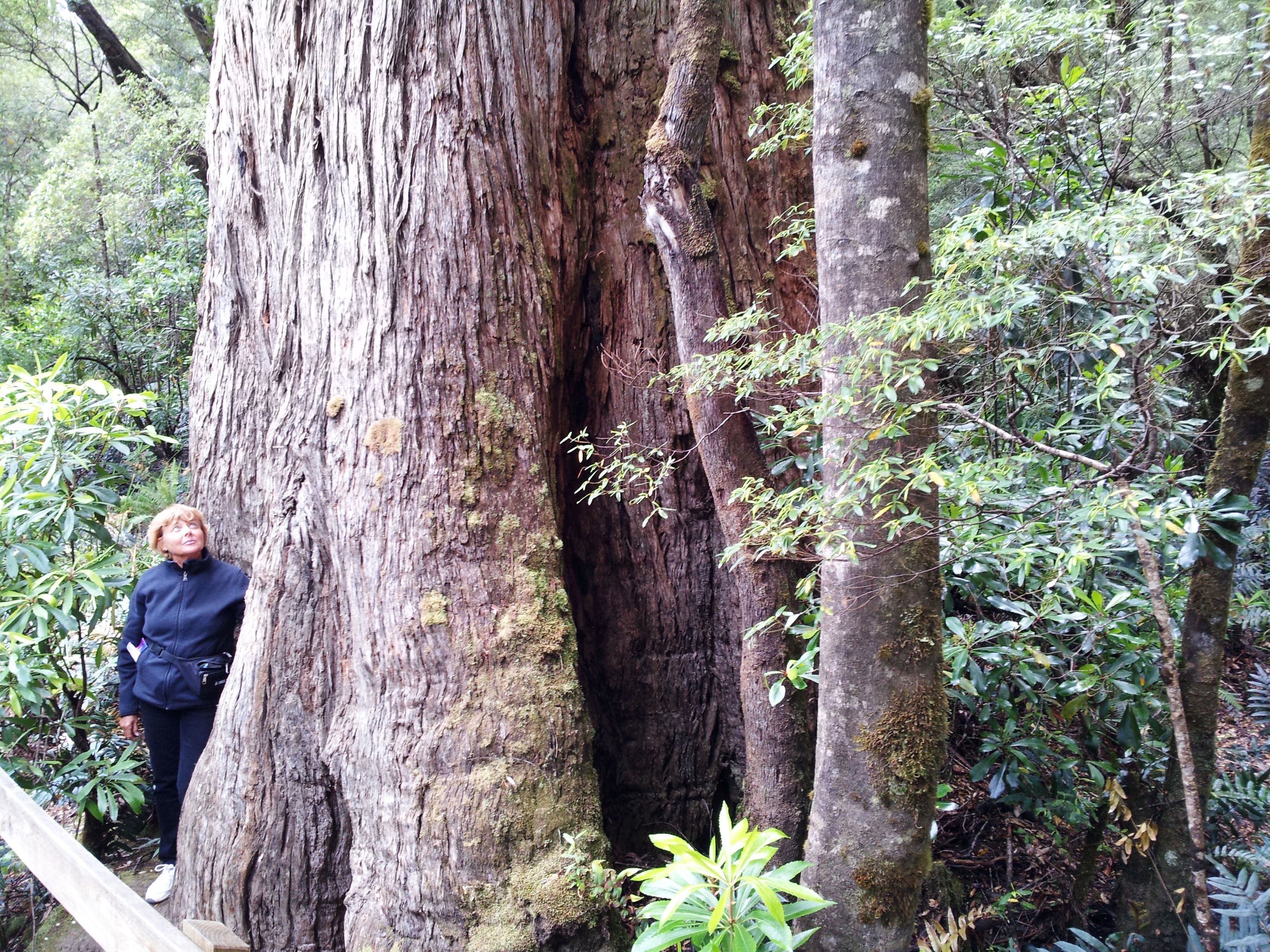
The eucalyptus trees are huge.
It is hard to portray the enormity of the the eucalyptus trees in this area.
It is hard to portray the enormity of the  eucalyptus trees in this area.

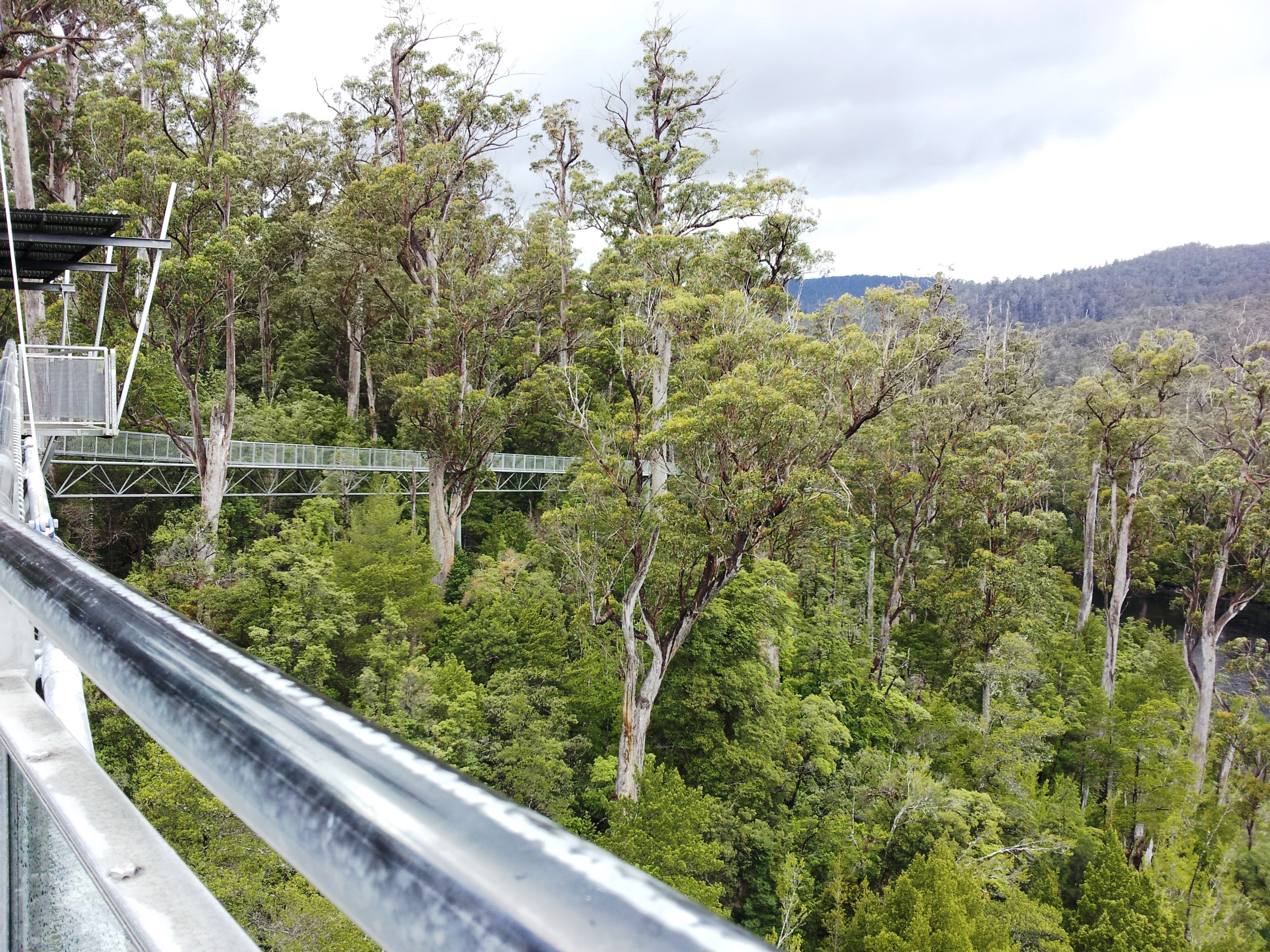
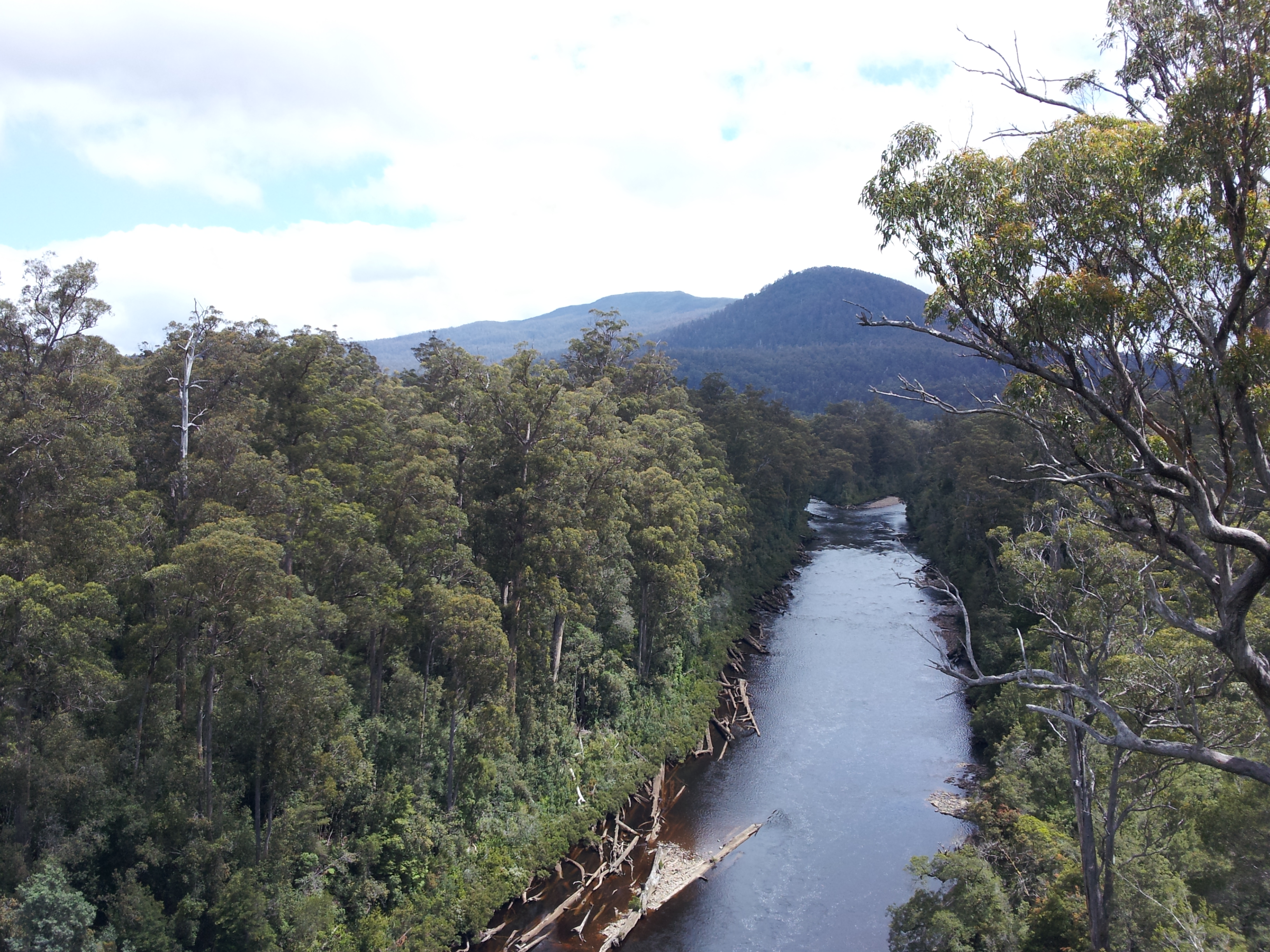
But one of the best things that this park has is The Tahune Airwalk!!! This was soooo cool! The airwalk is a long (1800 feet to be exact) walkway, but not just any walkway, this one rises to an average of 65 feet above the ground and to 156 feet above the river at the cantilever (that’s the arm that sticks out over the water without any support from below, eeeeek!) and wanders through the treetops. It is awesome! We walked along taking in the views and marveling at the scenery from above. It was fantastic.

1 More of the airwalk
The Airwalk
1The airwalk
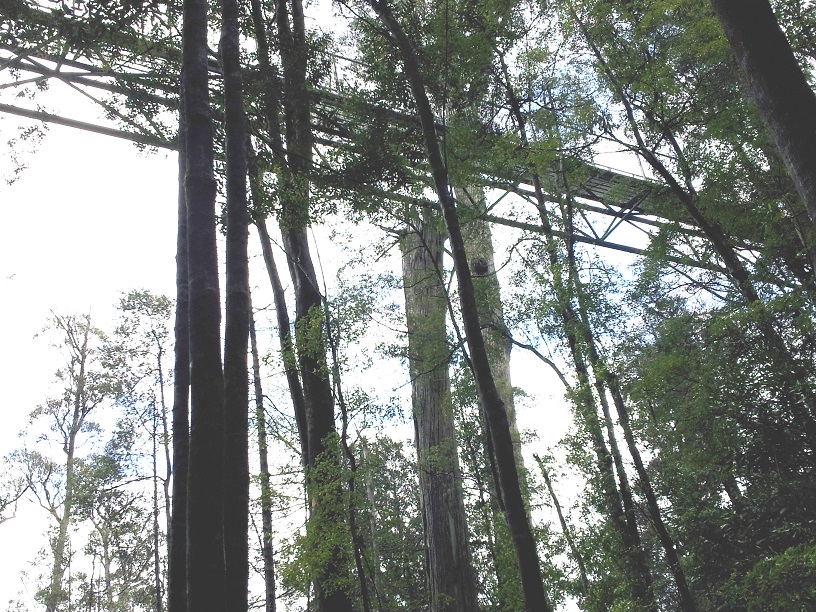
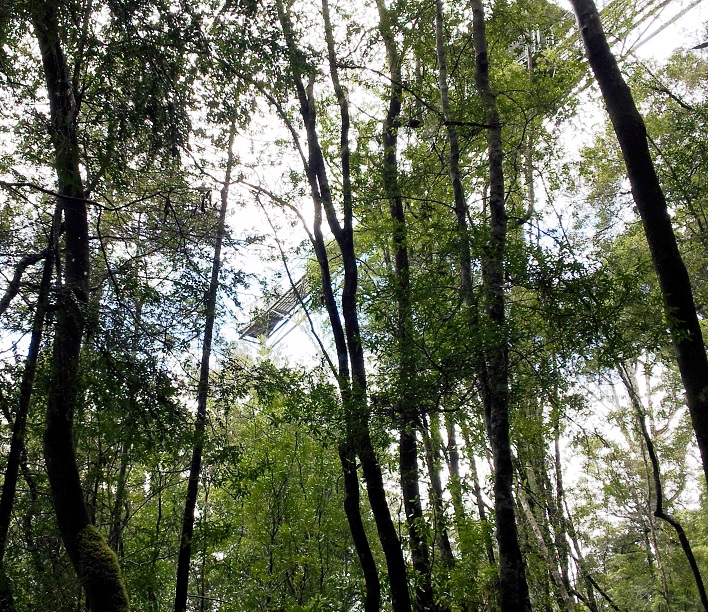
The airwalk from below.
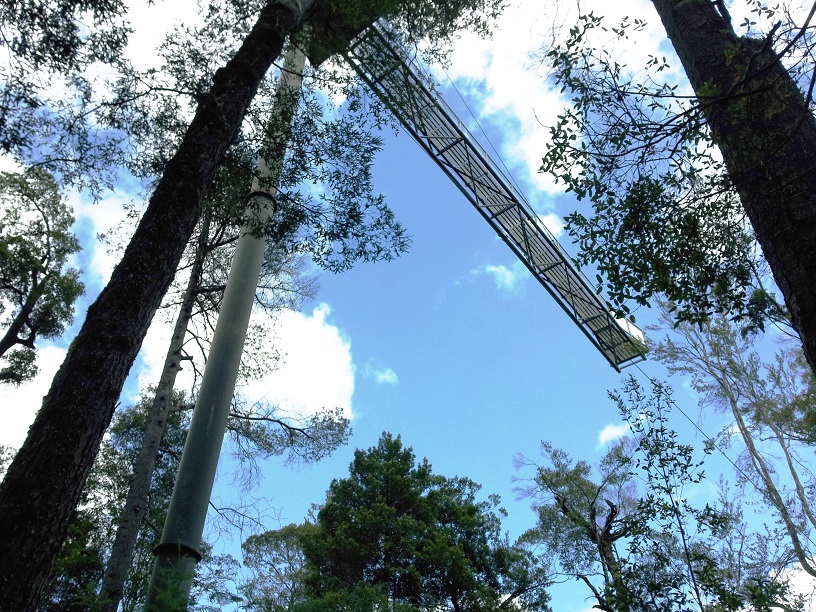
1 This is the cantelever from below. This arm sticks out over the  river without any ground support at the end. It swayed in the wind - a little unnerving when we were standing up there.
This is the cantilever from below. This arm sticks out over the river without any ground support at the end. It swayed in the wind – a little unnerving when we were standing up there.
1 Tom and I way up and out on the cantilever.
Tom and I way up and out on the cantilever.
1 Yet another view of the cantilever.
Yet another view of the cantilever. You have to look close (click to enlarge).

The Tahune (Aboriginal for “peaceful place by running water”)Park also has miles of trails and we spent the morning hiking around and enjoying the sights and reading about the history, the flora, and the fauna of the area.

More beautiful views
Peaceful Place by Running Waters
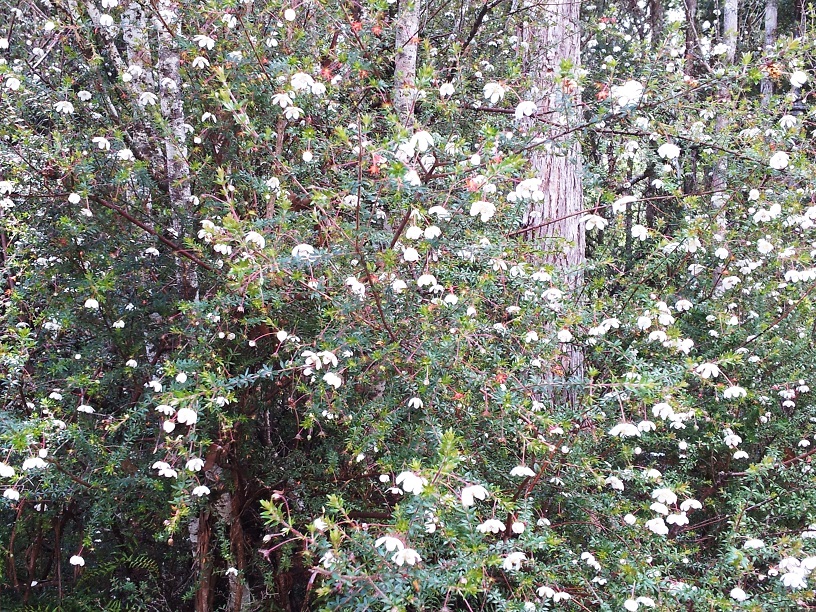
Flower lined pathways
2 Really long swinging bridges.
There were also really long swinging bridges.
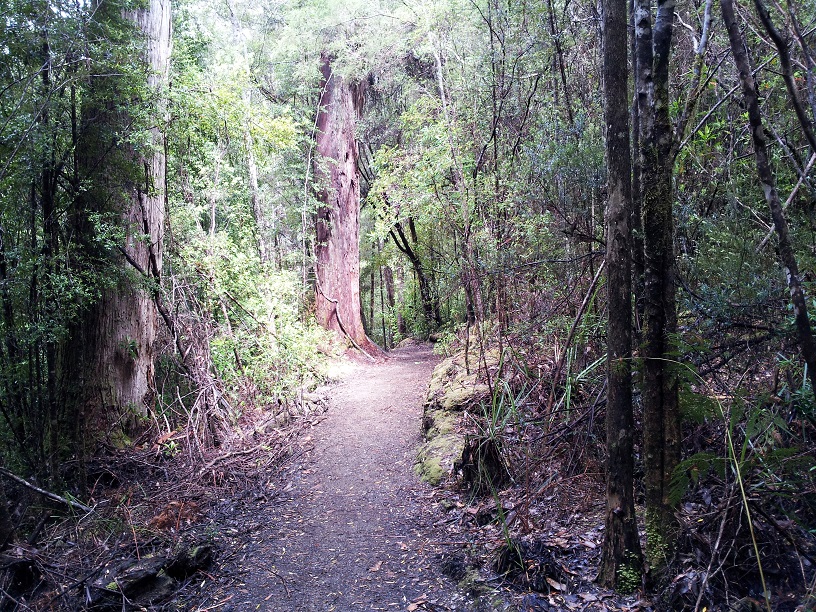
Hiking paths
Hiking paths
A huge fungi
This huge fungi was the size of a large platter.
3 Signs along the way gave information about the trees, bushes and surroundings
Signs along the way gave information about the trees, bushes and surroundings.
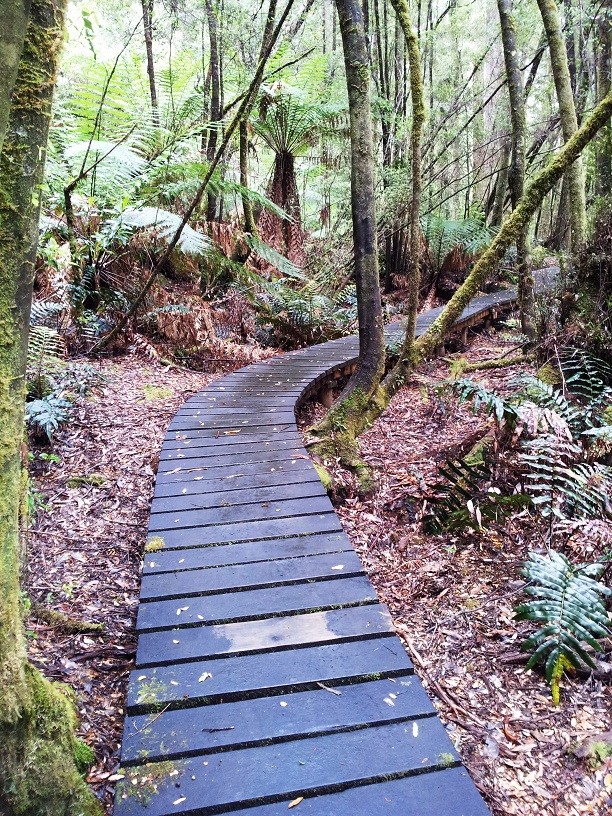
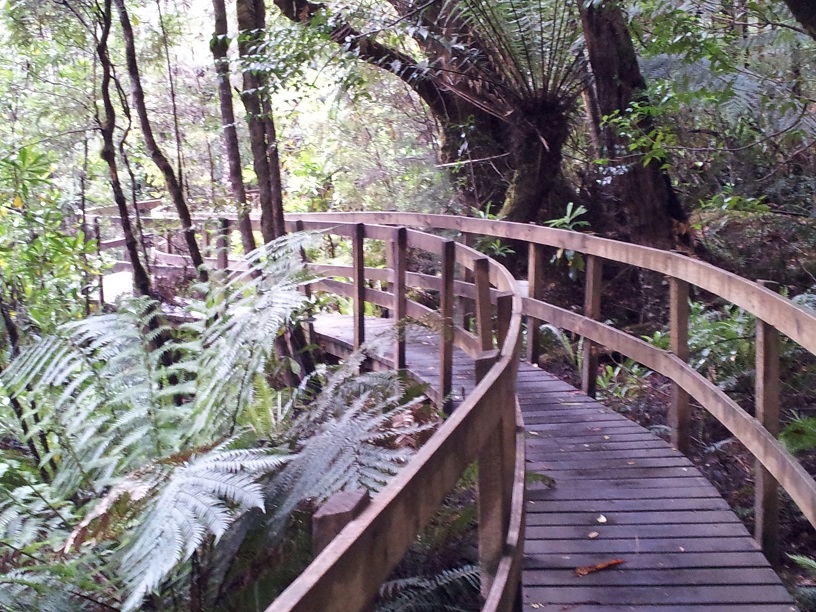
Walkways meandered through the forest and so did we.
Winding bridges
Winding bridges
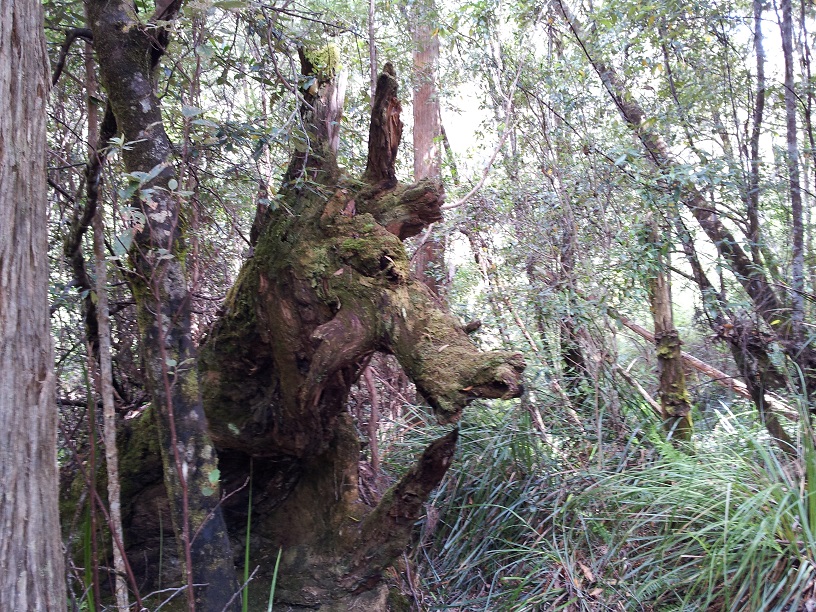
A kangaroo in the wild!! Okay, it's really just a log, but it kind of looks like a kangaroo.
A kangaroo in the wild!! Okay, it’s really just a log, but it kind of looks like a kangaroo.
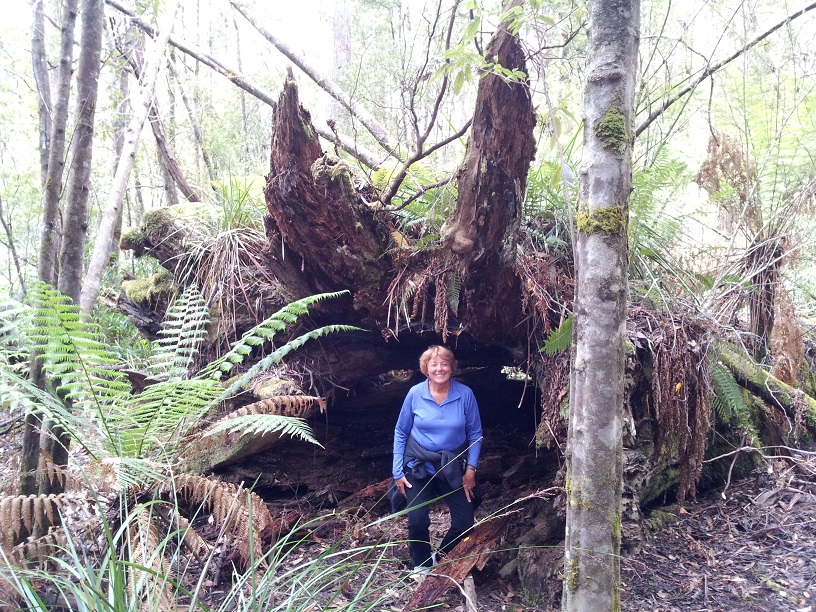
What a great den for some ot the wildlife.
Tahune Visitors Center
Tahune Airwalk Visitors Center

We took a leisurely break for lunch at the visitors’ center where we dined on salad and Bushman’s Beef Pie, delicious!

By the time we had finished, the sun had peeked through (I forgot to mention that Tasmania is one of the wettest places in Australia) so we rushed out to do the airwalk and many of the trails again. After about 6 miles total, we decided that we were pretty much spent so we left this peaceful place by running water and headed home with lovely memories and lots of pictures.

Beautiful river views
Goodbye, Tahune Airwalk